 Catalog


 MENU
MENU
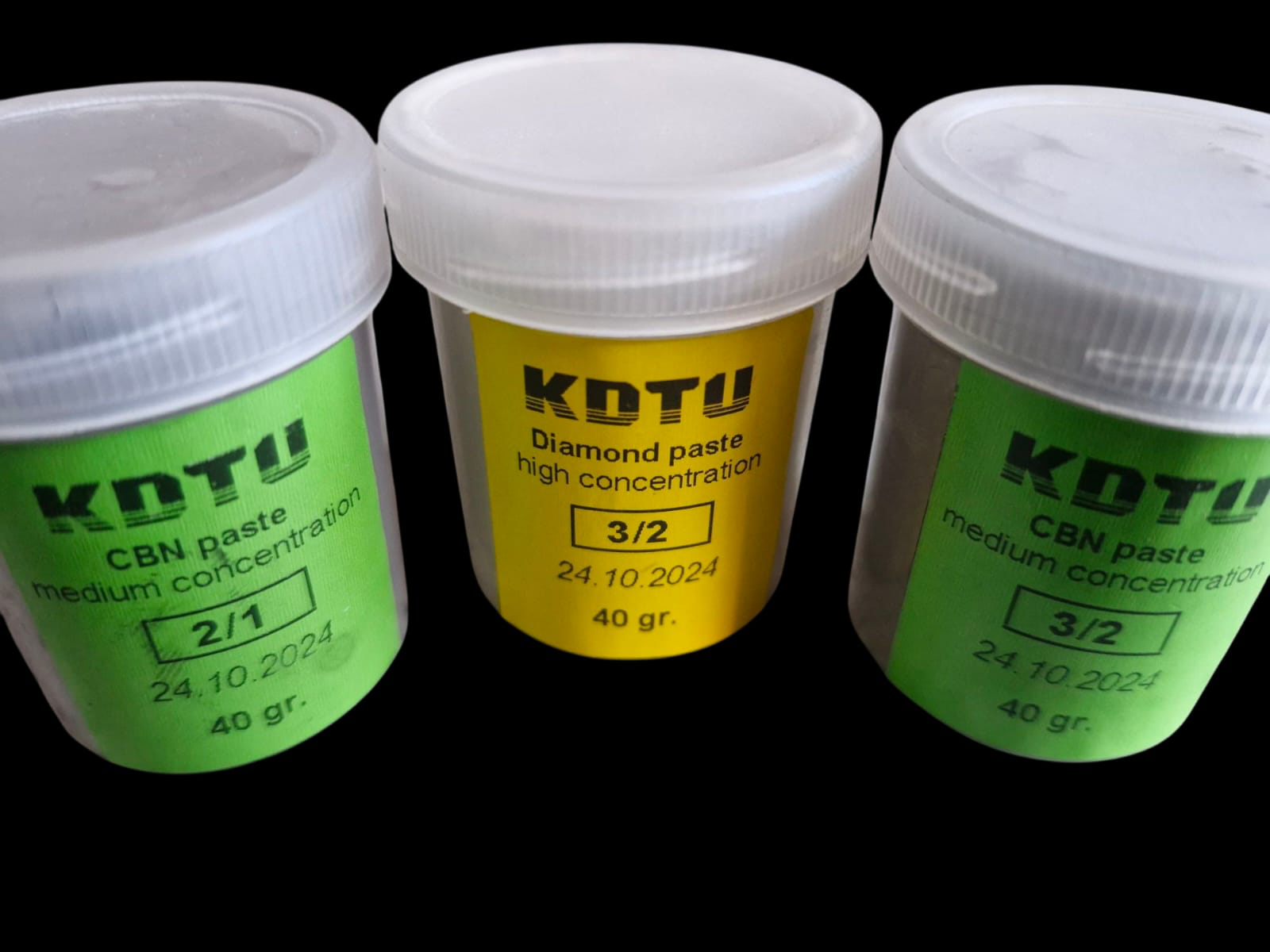
Let’s cut through the noise: when you’re grinding, polishing, or finishing metals, ceramics, or other stubborn materials, that mirror-smooth surface finish isn’t just luck—it’s about using the right abrasive paste. But here’s the kicker — choosing between diamond and CBN paste can still feel like a head-scratcher, even for seasoned pros.
Why? Because both pack serious power, but they’re not interchangeable. Get this right, and you’ll slice through production bottlenecks. Get it wrong, and you’re flushing time and money down the drain.
In this no-BS guide, we’re breaking down the nitty-gritty details most suppliers won’t tell you: what really matters when deciding between these two heavy hitters, how to match grit sizes and binders to your exact needs, and — most importantly — how to dodge those expensive rookie mistakes that sabotage surface quality. Let’s dive in.
Diamond vs CBN paste: the key to flawless machining
Diamond paste is a powerful tool made of microscopic diamond crystals that work as a precise “scalpel” for the surface. Its secret is its extreme abrasiveness, which makes it ideal for polishing the hardest materials: carbide, glass, ceramics. Imagine a tool that doesn’t just grind, but literally cuts away micro irregularities, leaving the surface flawless.
CBN (cubic boron nitride) paste is a technological trump card for metals that are “afraid” of temperature. Its particles are 20% softer than diamond particles, but this is what makes it the perfect helper for high-alloy steels, titanium or heat-resistant alloys. If diamond is the “impact force”, CBN is the strategy: it gently removes defects, avoiding overheating and preserving the structure of the material.
Grit: from brute force to jewel-like precision
Diamond paste comes in different types:
- 40-50 microns — for fighting deep scratches (like a “heavy machine gun” in the world of abrasives);
- 0,1-1 microns — for finishing gloss, where every micron determines the quality (like an artist’s brush).
CBN pastes also offer different gradations, but their advantage is heat resistance. Even during prolonged contact, they:
- Do not melt the surface;
- Do not deform, remaining stable at temperatures up to +300°C.
Important!
Diamond abrasives sometimes “mask” the problem: they close micropores on steel, creating the illusion of smoothness. CBN pastes work differently — they cut out defects without leaving marks, thanks to their controlled aggressiveness.
For copper, aluminum and other materials with high thermal conductivity:
- Diamond polishing paste is suitable — its formula minimizes heat;
- Not suitable to CBN for thin-walled parts — the risk of deformation increases many times.
To summarize:
- Diamond paste is the “king” for carbide, ceramics, glass.
- CBN paste is the “savior” for steels and titanium.
Choose wisely and your surface will shine like a mirror! And if in doubt, KDTU LLC experts will help you find the perfect balance between performance and efficiency.
Diamond paste classification and key parameters
Before buying diamond paste, it is significant to understand its classification. The main parameters are:
- The composition of diamond paste: the base (often oil or water) and the concentration of diamond powder.
- Granularity (FEPA or GOST).
- Purpose: for example, diamond paste for galvanizing laps is different from diamond paste for hand polishing.
If the diamond polishing paste has a fine grit (less than 5 microns), it is recommended to use it in the final stages when micro irregularities need to be removed. Coarser variants (20-40 microns) are effective for removing deep scratches.
Extras:
- Oil base provides better tool grip and longer life.
- Water base is suitable for automated systems with coolant supply.
- For jewelry or optics, pastes with added wax are used to prevent damage to fragile surfaces.
When to choose CBN paste?
CBN paste is a modern alternative to diamond abrasives. Its main advantage is its ability to work on materials that are highly viscous or prone to sticking. For example, when machining stainless steel or heat-resistant alloys, CBN pastes reduce the risk of burr formation.
Scope of CBN applications:
- Machining of steel workpieces in aircraft construction.
- Finish polishing of TiN (titanium nitride) coated tools.
- Working with materials where overheating is critical (e.g., precision engine parts).
It is also important to consider the economic aspect. While diamond pastes are typically less expensive, CBN can be more cost-effective due to its longer life when working on certain materials. For example, one pack of 10 µm CBN paste can replace 2-3 packs of diamond paste due to less wear.
Practical recommendations from KDTU LLC: how to avoid mistakes and achieve perfect results
- Paste selection for the material: precision is the key to success.
- Carbide, ceramic, glass? Diamond paste is your choice. Its micron diamond particles will “remove” even the toughest irregularities, leaving the surface as smooth as a mirror.
- Steel, titanium, heat-resistant alloys? CBN paste rules here. It works more gently, avoiding overheating, and is ideal for ductile metals.
- Combination materials? Combine! First diamond pastes for roughing, then CBN for a glossy finish.
- Grit: Staging is the secret to professional polishing.
Take your time with fine pastes! Start with 40-50 microns to remove deep scratches. Then move to 3-5 microns — this is the stage where the shine appears. And for a mirror effect, add an aluminum oxide finish. - Paste base: not all mediums are the same.
- Water-based is for cooled machines. Leaves no film, ideal for automation.
- Oil base — for custom workshops. Does not dry out, lies perfectly on stamps during manual polishing.
- Testing: check before you start — your insurer.
Before you buy diamond paste in a batch, test it on a “proving ground”:- Apply to a test area.
- Measure the processing time.
- Make sure the surface is not overheated.
- Evaluate the result under different light angles.
- Storage: where work ends, care begins.
Even the best quality diamond polishing paste will lose its effectiveness if:- The tube stands under the sun — ultraviolet destroys the binding components.
- The cap is not closed — the base dries out and the particles delaminate.
3 mistakes that negate the result
- Diamond paste for steel parts.
Consequence: abrasive rubs off in 10 minutes, surface burns fingers. - Trying to “jump” through the steps.
Consequence: thin paste “preserves” scratches — you will have to start over. - “Lots of material means better”.
Consequence: excess clogs the tool, increases costs by 30%.
Why do customers choose KDTU LLC?
We don’t sell pastes — we sell solutions. Here’s what you get:
- Quality.
The goods meet all standards and are of good quality. - Paste for your tasks.
We can find the right paste for any task. - Turnkey savings calculation.
Our managers will tell you how much paste you need for a shop with 1000 parts/day — so you don’t overpay for excess. - Diamond and CBN pastes — from 5 microns to 100 microns.
From roughing to jewelry polishing — all in one line.
Bottom line: your success starts with the right choice of diamond or CBN paste
- Hard materials? Only diamond paste — it has no rival when working with carbide or ceramics.
- Metals that are “afraid” of temperature? CBN paste — minimum friction, maximum efficiency.
- In doubt? Click “Call” — our experts will analyze your case to the last detail.
To order diamond and CBN pastes, please contact us by phone +38 050 889 82 89 or by e-mail kdtu-1@ukr.net. Our specialists will help you with your choice and provide answers to all your questions.