 Catalog


 MENU
MENU
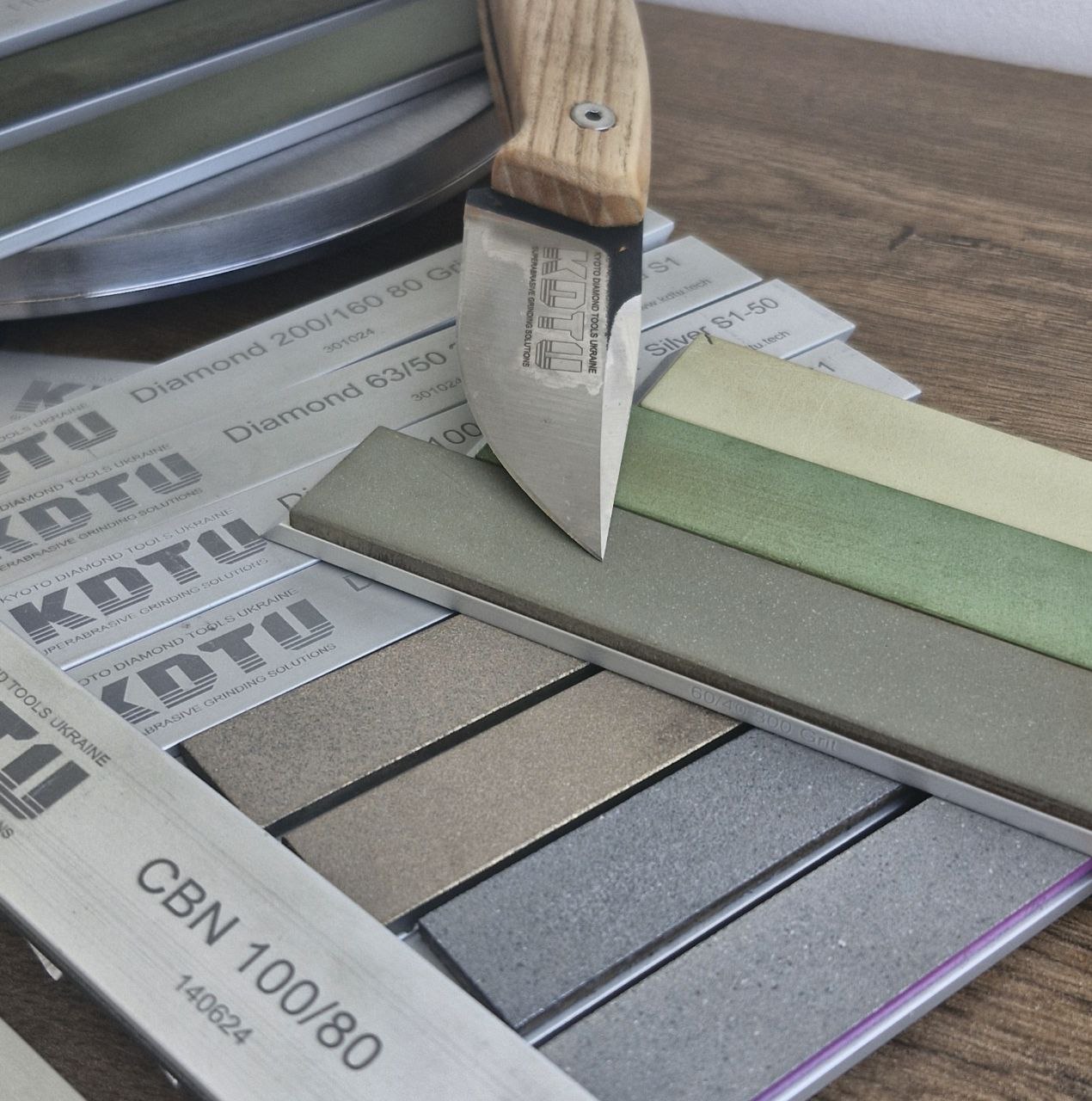
Introduction
Our company started the production of abrasive stones at the request of one of our clients. As you know, earlier we manufactured exclusively professional and specialized tools, mainly for the machine-building and woodworking industries. These were tools for CNC machines for producing carbide cutting tools, for sharpening industrial steel knives, and for many other specific grinding applications.
As a result, the task was set — to create sharpening stones that could compete in quality with well-known manufacturers. One of the main requirements was to study the properties of natural stones and the sharpening mechanics used by traditional craftsmen.
Based on this, we studied the structure, chemical composition, and mechanical properties of natural stones. We then tried to reproduce their analogs, but manufactured using modern materials and production methods applied in machine-building and woodworking.
Structure of the Abrasive Layer
In our stones we use different types of abrasive fillers. But the main ones, without a doubt, are diamond and cubic boron nitride (CBN or Elbor). The correct proportion of these components and bonding agents creates favorable conditions for sharpening different types of steels.
As is well known, the main grinding element — you have probably guessed — is either diamond or CBN. As a rule, we prefer to use CBN, since it is specifically intended for steel processing.
CBN has a crystal shape similar to natural abrasives, but in an enlarged size. In combination with secondary polishing fillers, CBN makes it possible to work with steels of any hardness. Moreover, it does not tear the cutting edge. Instead, it leaves the most uniform scratches (grooves formed after material displacement by CBN crystals).
Comparison of Bond Types: Metallic, Organic, and Hybrid
Hybrid bonds demonstrate high performance, even in comparison with metallic bonds. In particular, with tin-copper types such as M2-01 (commonly called Bronze) or aluminum-based bonds such as M1-01 (also known as Silver). The wear resistance of a hybrid bond is not inferior to that of M1-01 bonds. Moreover, it is four times more durable than organic bonds such as phenol-formaldehyde resin or epoxy resin.
For reference, in the production of diamond tools for industrial enterprises, bonds are usually divided into two main groups: metallic and organic.
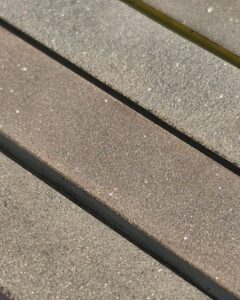
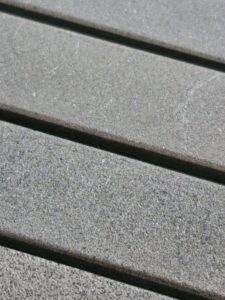
A bond is the binding substance that holds the abrasive grains on the working surface of the tool. Metallic bonds, in turn, are divided into two types.
Metallic Bonds
- M2-01: based on copper and tin with the addition of tungsten, cobalt, nickel, and iron. It has a yellowish color. This is probably the hardest and most durable bond, capable of holding high-strength diamonds. Therefore, it is mainly used for processing glass, stone, and ceramics.
- M1-01: aluminum-zinc with a small addition of copper. This bond is very complex and more expensive to manufacture. Since it is softer than M2-01, it has not become as popular. Its primary purpose is the processing of hard alloys.
Organic Bonds
Organic bonds are binders where the bonding element of the abrasives in the working layer is resin (an organic compound). It may differ in composition and name. As a result, the quality of the resin determines the ability to hold superabrasives on the surface.
This is the most common bond, which was the first to be applied in the production of diamond and CBN stones. In mechanical engineering, they are designated as B2-01 and B1-01.
-
B2-01 — pure phenolic resin, black or dark gray in color.
-
B1-01 — resin bond with added copper for higher loads and better heat dissipation from the grinding zone; has a reddish tint.
These are soft bonds. As is well known, they are not capable of holding strong diamonds, similar to the M2-01 bond.
Hybrid Bonds
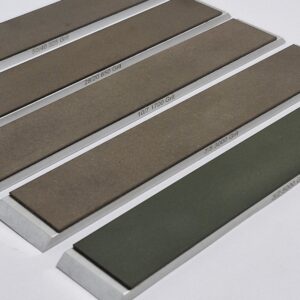
Hybrid bonds are the latest developments based on modern resins. Without a doubt, they differ from standard phenolic resins by their high strength, and therefore they are capable of holding diamonds, just like M2-01 and its varieties.
The huge advantage of hybrid bonds lies not only in their increased durability and performance but also, without question, in ease of use.
Stones can generally be used without lubricating fluids, or they can be wetted with water, oil, or soap. In any case, the result will always be excellent. Hybrid bonds do not strain the hand during sharpening, unlike metallic bonds.
Stones are very easy to dress. The dressing process is the same as with stones on organic bonds. Hybrid bonds have good self-dressing properties (the self-exposure of diamond or CBN crystals due to friction against steel). They do not need frequent dressing on glass (or a lapping plate).
The self-dressing process can be observed during sharpening: fine dark dust is formed along with steel shavings. But this does not mean that the stone wears quickly. The abrasive grains are held strongly in the bond. The stone confidently maintains a flat working surface.
As practice has shown, a single stone can sharpen about 200 knives of various steels — from soft stainless steel to hard steels over 60 HRC, without any signs of “saddle” on the surface.
Essentially, a hybrid bond is a universal bond for all types of steel.
In metalworking, there is a fundamental principle:
“Soft is processed with hard, hard is processed with soft.”
In other words, soft steels are best processed with hard copper bonds, and hard steels with soft phenolic bonds. Hybrid bonds occupy a middle position in hardness, thus achieving a “golden ratio” in terms of durability, performance, and edge quality.
Purpose of Hybrid Bonds
We offer our clients several types of stones with different abrasive layer properties:
-
Traditional hybrid bond, which has moderate material removal intensity. At the same time, this bond allows excellent control over the sharpening process even for the most capricious powdered, brittle, and crumbly steels.
-
Bond with increased abrasiveness (or increased material removal intensity). Usually recommended for use with coarse and medium grit when very fast sharpening or significant correction of the knife edge is needed. But even with fine CBN grits, it will handle its task well without creating separate deep scratches.
-
Bonds for finishing with especially fine diamond or CBN crystals. We designed these bonds to maximally approximate the sharpening quality of natural or water stones. These bonds contain crystals from 5 to 2 microns. They can sharpen a knife blade almost to a mirror finish without damaging carbides in particularly hard steels. The knife’s cutting ability is preserved.
-
Bond for more decorative sharpening with crystals smaller than 0.3 microns. This bond allows obtaining a fully mirror surface on the knife blade. With such stones, one can completely replace polishing with abrasive pastes.
Despite the popularity of hybrid bonds, we can offer stones on metallic bonds of our Gold and Silver series. These bonds are for lovers and connoisseurs of classic stones on metallic binders.
Stone Maintenance
During use, stones have the property of clogging with steel shavings, which affects the speed of the stone. The fastest way to clean the stone is to apply a little oil to its surface and wipe across the entire plane. You will see how all the slurry quickly appears on the surface. It is very easy to wipe off with a napkin or any cloth. Thoroughly wipe the stone, and you can confidently continue working.
After work, the stone should be well washed in water with soap and placed back in the box for storage.
How to Assemble a Set of Stones
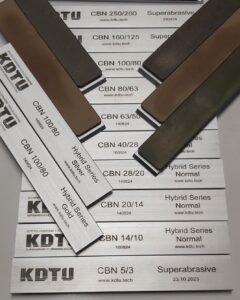
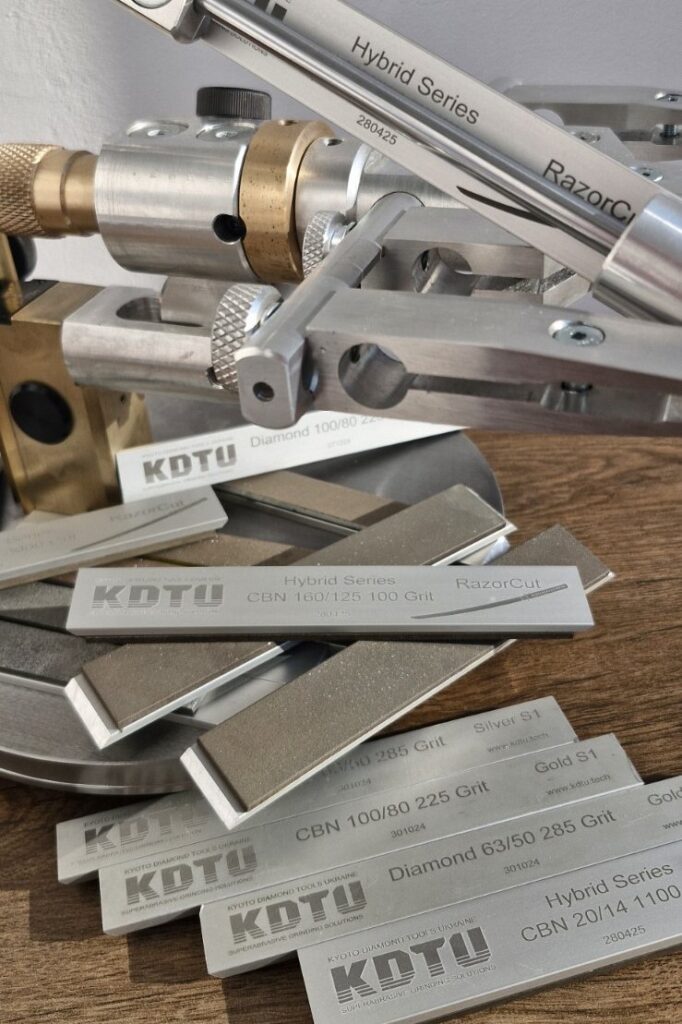
Variety of stones on hybrid bonds
To choose a set of stones, you first need to understand what knives you will work with and what budget you are counting on.
If you plan to work with all types of knives, with various serious damages, or sharpen blanks from scratch to a mirror finish, you will need a full set of stones starting from:
-
Roughing: 315/250; 250/200; 200/160; 160/125; 125/100
-
Middle stage: 100/80; 80/63; 63/50; 50/40; 40/28
-
Finishing: 28/20; 20/14; 14/10; 10/7
-
Polishing, which starts giving a mirror effect: 7/5; 5/3; 3/2; 2/1
If a cleaner finish is needed, lapping stones with pastes, emulsions, and natural stones are used.
Sets are usually formed from one or two roughing stones, and then middle and finishing stages are selected in one-step intervals, e.g., after 100/80 or 80/63, then 50/40 or 40/28.
For hunting knives working in harsh conditions, it is enough to choose a set ending with grit 28/20 or 20/14. If you still want a slight mirror shine, you can finish with 10/7. After that, it is not necessary. The first contact with bone or another hard object will scratch the knife, and on a perfectly mirror surface, it will be very noticeable.
Do not forget that sharpening stones must form a clearly defined uniform micro-serration on the knife edge, which affects the aggressiveness of cutting rough materials and the durability of the cutting edge. At the same time, it is necessary to correctly select the sharpening angle for each type of knife.
For beginners who want to sharpen kitchen or tourist knives, it is recommended to start with one or two stones with grits 50/40 and 28/20. You can start without a machine.
From budget options, our company can offer stones from the professional line with a working layer thickness of 1 mm.
If you have any questions, contact us at +38 050 889 82 89 or kdtu-1@ukr.net. We will be happy to answer all questions and help with selection.
This article is also available in RU and UA.