Catalog
UARUEN
MENU
MENU
Catalog

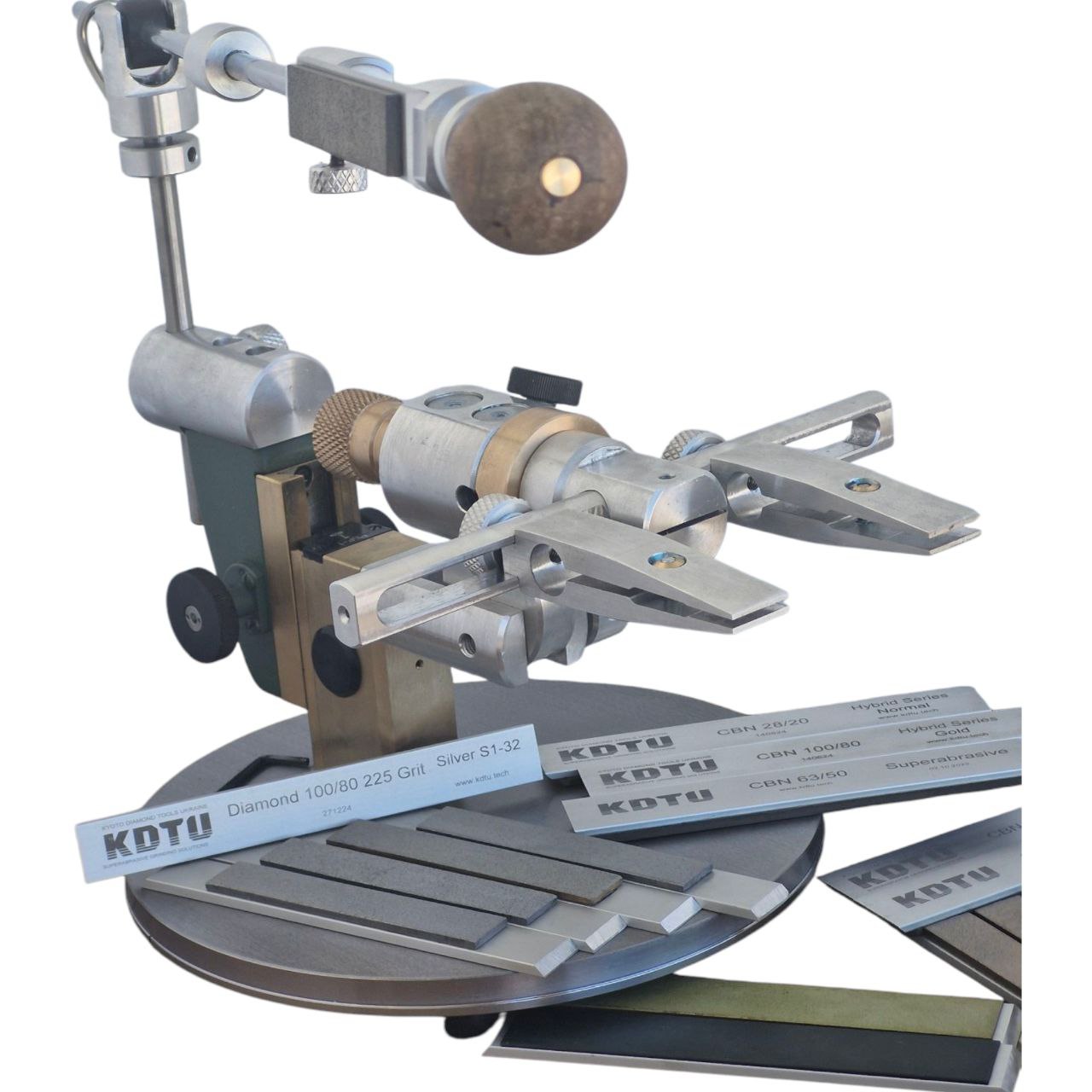
CBN bars, hybrid bond size 150x25x3 mm, on an aluminum blank 160x25x4 mm;

Product Description

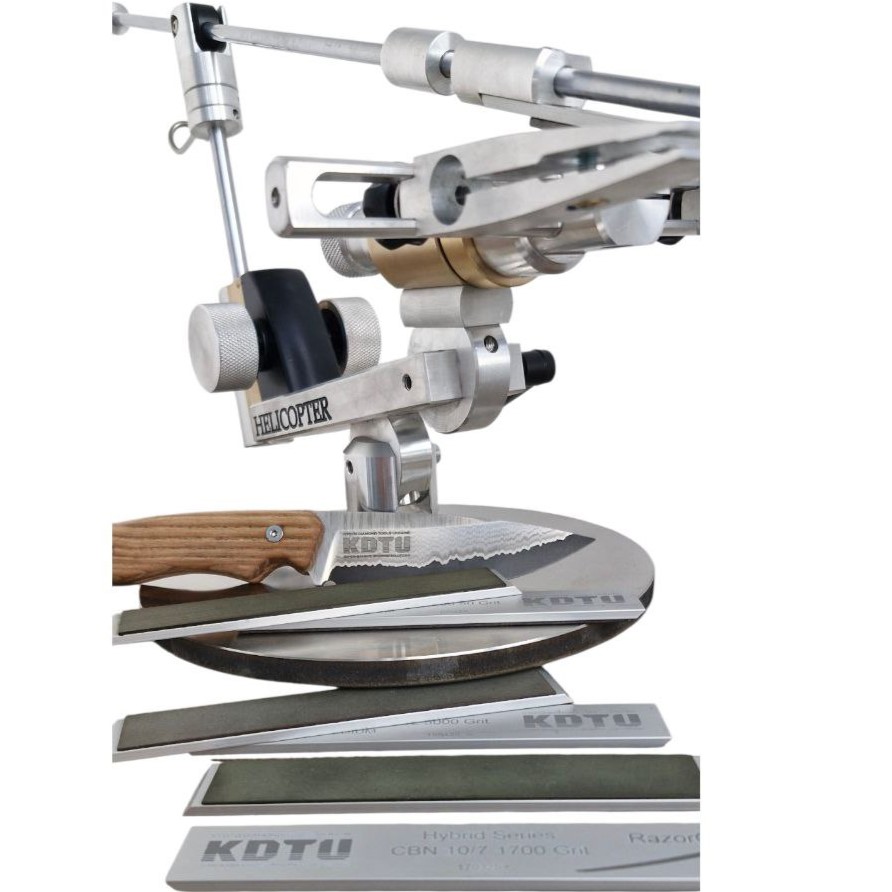
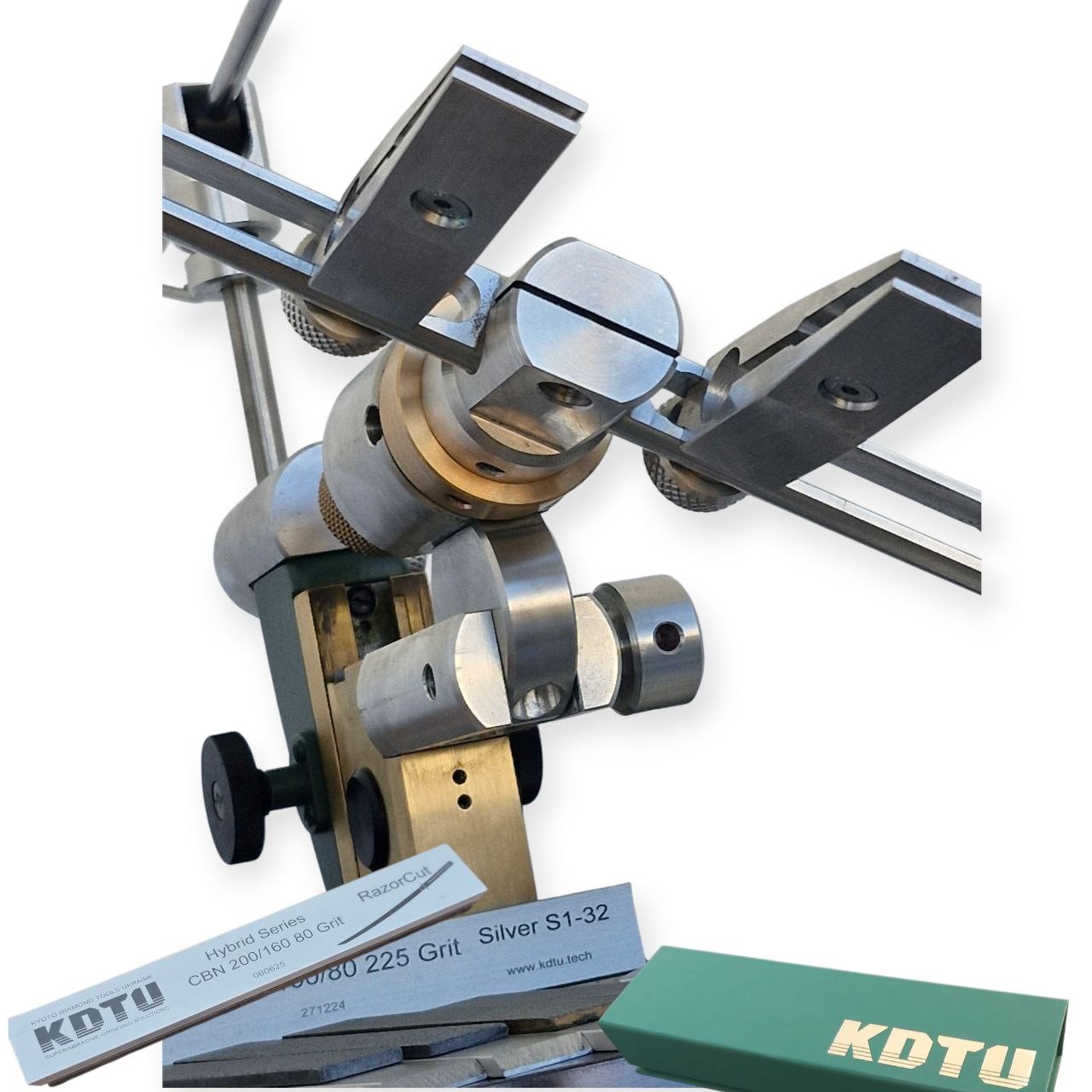
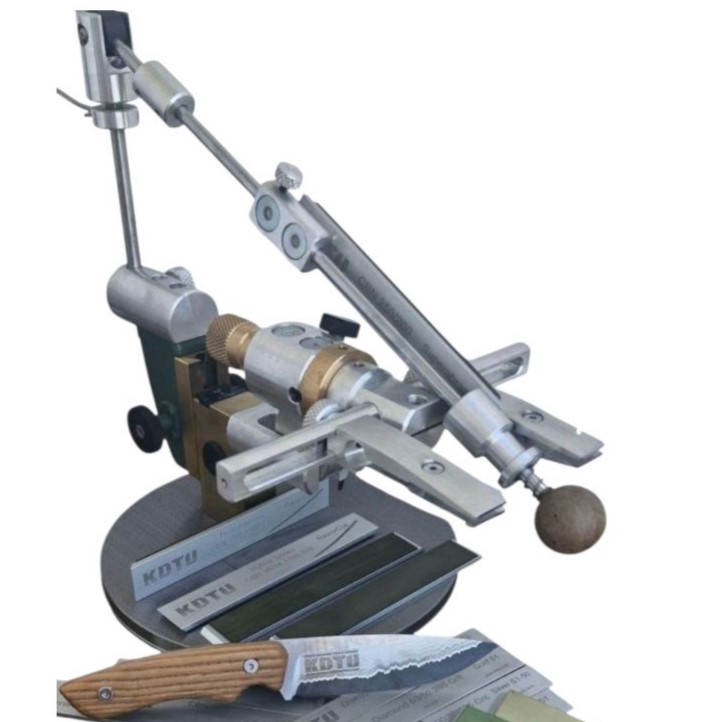
Currently, Kyoto Diamond Tools Ukraine (KDTU) manufactures diamond and CBN sharpening bars on a hybrid bond measuring 150x25x3 on an aluminum blank measuring 160x25x4. It is the hybrid bond that provides the most comfortable sharpening with a high-quality result. The bars are made on modern modified resins in combination with non-ferrous metal powders and components for self-healing of the working surface of the bar. This product is suitable for both manual work and work on Apex machines, such as Hapstone, TS-Prof and others.

Advantages of KDTU bars on a hybrid bond:

  1. Universality – they work equally productively on hard and soft steels.
  2. Very high productivity, they work twice as fast as metal and phenolic bonds.
  3. They have a very good ability to self-heal the working surface.
  4. At the stripping stage, they give a cleaner surface, close to the middle stage.
  5. They give the homogeneity of the risk at the level of PC Borid.
  6. They have an average hardness between metal and phenolic bars, which makes them universal.
  7. Quite high resistance, 4 times greater than any phenolic.
  8. They are able to work with hard steels at maximum hardening limits. We are talking about more than 67 HRC, without chipping the cutting edge of the knife.
  9. They work both dry and with any types of emulsions and oils without restrictions.
  10. They are easy to straighten at the leveling stage and quickly open when it is necessary to increase the aggression of the bar.
  11. They are quickly cleaned from grease with an oil or damp cloth.
  12. They have a medium price range between metal and phenolic bars.

CBN bar – external features

Hybrid bond whetstones may have some multi-colored streaks on the surface of the working layer, like on natural stones. They may differ in shades. This depends on the size of the abrasive grain in the whetstone or be lighter or darker even on the same grains. The quality of sharpening whetstones does not depend on the shades and color of the working surface.

The grain size of the tool and its effect on sharpening:

The production of whetstones is carried out from diamond and CBN powders from 315/250 to 2/1 microns or from 50 grit to 10000 grit.

  • For the purpose of rough processing of the knife blade during the formation of the cutting edge of the knife. Or for cleaning nicks, cracks or fractures on knives after their use, powders of 250/200 to 100/80 microns or from 60 to 170 grit are used;
  • For the purpose of sharpening the cutting edge, powders of 80/63-20/14 microns or from 200 to 1000 grit are used;
  • For the purpose of polishing the cutting edge of the knife, powders of 20/14 microns or 1000 grit and lower are used.

It is better to use finishing whetstones for polishing with oil to improve the purity of the knife edge surface.

After finishing work, you can wash it with a sponge under running water and soap.

Contact us and we will help you with the choice. Be sure, our product is one of the best on the market!

Diamond bars, hybrid bond size 150x25x1 mm, on an aluminum blank 160x25x4 mm;

Hybrid-Bond Diamond Sharpening Stones 150x25x1 mm

Product Description

Kyoto Diamond Tools Ukraine (KDTU) proudly offers professional-grade diamond and CBN sharpening stones on a hybrid bond, specifically designed for precision sharpening and polishing. Available in 150×25×1 mm format on a durable 160×25×4 mm aluminum blank, these stones are a game-changing upgrade over standard electroplated stones.


🔹 Why Choose Hybrid Over Electroplated Stones?

Smoother, More Controlled Sharpening

Our hybrid bond technology provides an exceptionally smooth sharpening experience with consistent feedback and superior edge quality. Formulated using advanced resins, non-ferrous metal powders, and self-renewing components, the stone resists clogging and retains cutting performance from start to finish.

Performance That Lasts

Unlike electroplated stones, which lose cutting aggressiveness after ~20% of use, hybrid stones maintain their cutting power throughout the entire life cycle. You can refresh the surface using abrasive powders to restore maximum efficiency when needed.

Up to 20x Longer Service Life

Electroplated stones feature a single abrasive layer. In contrast, hybrid stones contain multiple abrasive layers, meaning they last significantly longer:

  • 315-micron grit → ~3 abrasive layers per 1 mm
  • 50-micron grit → ~20 layers
  • 2-micron polishing stones → up to 500 ultra-fine layers

This translates into unmatched longevity and cost-efficiency.

Lower Long-Term Cost

Over the lifetime of one 1 mm hybrid stone, you’d typically need to replace 8 to 20 electroplated stones of similar grit. That makes hybrid stones not just better — but smarter from a cost perspective.


🔧 Compatible With All Popular Sharpening Systems

Perfectly suited for both freehand sharpening and guided sharpening systems, including:

  • Hapstone
  • TS-Prof
  • KME
  • Helicopter
  • Apex-style systems, and more

📐 Tech Corner: Layer Density Explained

Want to know how many abrasive layers are packed into a hybrid stone? Here’s the math:

  • Abrasive size is measured in microns (µm), where 1 µm = 0.001 mm.
  • A 315 µm diamond grain = 0.315 mm → 1 mm / 0.315 mm ≈ 3.17 layers
  • A 50 µm grain = 0.05 mm → 1 mm / 0.05 mm = 20 layers
  • A 20 µm grain = 0.02 mm → 1 mm / 0.02 mm = 50 layers

👉 The finer the grit, the more layers — the longer it lasts.


💡 Invest Once. Sharpen for Years.

KDTU hybrid-bond sharpening stones are engineered for professionals and enthusiasts who demand longevity, consistency, and quality. Whether you’re restoring a high-end kitchen knife or finishing a straight razor, these stones deliver precision results with real economic value.

CBN bars, hybrid bond size 150x25x1 mm, on an aluminum blank 160x25x4 mm

Hybrid-Bond CBN Sharpening Stones

Product Description

Kyoto Diamond Tools Ukraine (KDTU) proudly offers professional-grade diamond and CBN sharpening stones on a hybrid bond, specifically designed for precision sharpening and polishing. Available in 150×25×1 mm format on a durable 160×25×4 mm aluminum blank, these stones are a game-changing upgrade over standard electroplated stones.


🔹 Why Choose Hybrid Over Electroplated Stones?

Smoother, More Controlled Sharpening

Our hybrid bond technology provides an exceptionally smooth sharpening experience with consistent feedback and superior edge quality. Formulated using advanced resins, non-ferrous metal powders, and self-renewing components, the stone resists clogging and retains cutting performance from start to finish.

Performance That Lasts

Unlike electroplated stones, which lose cutting aggressiveness after ~20% of use, hybrid stones maintain their cutting power throughout the entire life cycle. You can refresh the surface using abrasive powders to restore maximum efficiency when needed.

Up to 20x Longer Service Life

Electroplated stones feature a single abrasive layer. In contrast, hybrid stones contain multiple abrasive layers, meaning they last significantly longer:

  • 315-micron grit → ~3 abrasive layers per 1 mm
  • 50-micron grit → ~20 layers
  • 2-micron polishing stones → up to 500 ultra-fine layers

This translates into unmatched longevity and cost-efficiency.

Lower Long-Term Cost

Over the lifetime of one 1 mm hybrid stone, you’d typically need to replace 8 to 20 electroplated stones of similar grit. That makes hybrid stones not just better — but smarter from a cost perspective.


🔧 Compatible With All Popular Sharpening Systems

Perfectly suited for both freehand sharpening and guided sharpening systems, including:

  • Hapstone
  • TS-Prof
  • KME
  • Helicopter
  • Apex-style systems, and more

📐 Tech Corner: Explanation of the number of layers in 1mm of sharpening stone

Want to know how many abrasive layers are packed into a hybrid stone? Here’s the math:

  • Abrasive size is measured in microns (µm), where 1 µm = 0.001 mm.
  • A 315 µm diamond grain = 0.315 mm → 1 mm / 0.315 mm ≈ 3.17 layers
  • A 50 µm grain = 0.05 mm → 1 mm / 0.05 mm = 20 layers
  • A 20 µm grain = 0.02 mm → 1 mm / 0.02 mm = 50 layers

👉 The finer the grit, the more layers — the longer it lasts.


💡 Invest Once. Sharpen for Years.

KDTU hybrid-bond sharpening stones are engineered for professionals and enthusiasts who demand longevity, consistency, and quality. Whether you’re restoring a high-end kitchen knife or finishing a straight razor, these stones deliver precision results with real economic value.

Diamond bars, hybrid bundle size 150x25x3 mm, on an aluminum blank 160x25x4 mm;

Product Description

Currently, Kyoto Diamond Tools Ukraine (KDTU) manufactures diamond and CBN sharpening bars on a hybrid bond measuring 150x25x3 on an aluminum blank measuring 160x25x4. It is the hybrid bond that provides the most comfortable sharpening with a high-quality result. The bars are made on modern modified resins in combination with non-ferrous metal powders and components for self-healing of the working surface of the bar. This product is suitable for both manual work and work on Apex machines, such as Hapstone, TS-Prof and others.

Advantages of KDTU bars on a hybrid bond:

  1. Universality – they work equally productively on hard and soft steels.
  2. Very high productivity, they work twice as fast as metal and phenolic bonds.
  3. They have a very good ability to self-heal the working surface.
  4. At the stripping stage, they give a cleaner surface, close to the middle stage.
  5. They give the homogeneity of the risk at the level of PC Borid.
  6. They have an average hardness between metal and phenolic bars, which makes them universal.
  7. Quite high resistance, 4 times greater than any phenolic.
  8. They are able to work with hard steels at maximum hardening limits. We are talking about more than 67 HRC, without chipping the cutting edge of the knife.
  9. They work both dry and with any types of emulsions and oils without restrictions.
  10. They are easy to straighten at the leveling stage and quickly open when it is necessary to increase the aggression of the bar.
  11. They are quickly cleaned from grease with an oil or damp cloth.
  12. They have a medium price range between metal and phenolic bars.

CBN bar – external features

Hybrid bond whetstones may have some multi-colored streaks on the surface of the working layer, like on natural stones. They may differ in shades. This depends on the size of the abrasive grain in the whetstone or be lighter or darker even on the same grains. The quality of sharpening whetstones does not depend on the shades and color of the working surface.

The grain size of the tool and its effect on sharpening:

The production of whetstones is carried out from diamond and CBN powders from 315/250 to 2/1 microns or from 50 grit to 10000 grit.

  • For the purpose of rough processing of the knife blade during the formation of the cutting edge of the knife. Or for cleaning nicks, cracks or fractures on knives after their use, powders of 250/200 to 100/80 microns or from 60 to 170 grit are used;
  • For the purpose of sharpening the cutting edge, powders of 80/63-20/14 microns or from 200 to 1000 grit are used;
  • For the purpose of polishing the cutting edge of the knife, powders of 20/14 microns or 1000 grit and lower are used.

It is better to use finishing whetstones for polishing with oil to improve the purity of the knife edge surface.

After finishing work, you can wash it with a sponge under running water and soap.

Contact us and we will help you with the choice. Be sure, our product is one of the best on the market!

Diamond wheels for woodworking and their advantages

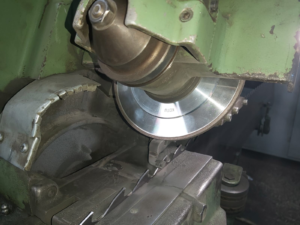
Diamond wheel for woodworking in use | KDTU

Woodworking cannot be called simply a production process, because in its course whole works of art are often created. Agree, it has happened that when you came to visit friends or relatives, you noticed a very beautiful table, or a high-quality countertop. Such details immediately catch the eye and make the design more refined and attractive. However, we want to note that in order to achieve such a result in woodworking, you must use an accurate, high-quality and reliable tool. The choice of tool is important, because not only the final result, but also the entire working process depends on it. Therefore, in this article we want to tell you about diamond wheels for woodworking and their advantages, so that if you have the desire, you yourself can create your own masterpiece from wood.

What are diamond wheels for woodworking?

A tool used for grinding, cutting or sharpening various materials is a diamond wheel. Woodworking tools of this type are made of reliable materials and have a feature in the form of a diamond coating, which allows ensuring the hardness and abrasiveness of the wheel.

Types of diamond wheels

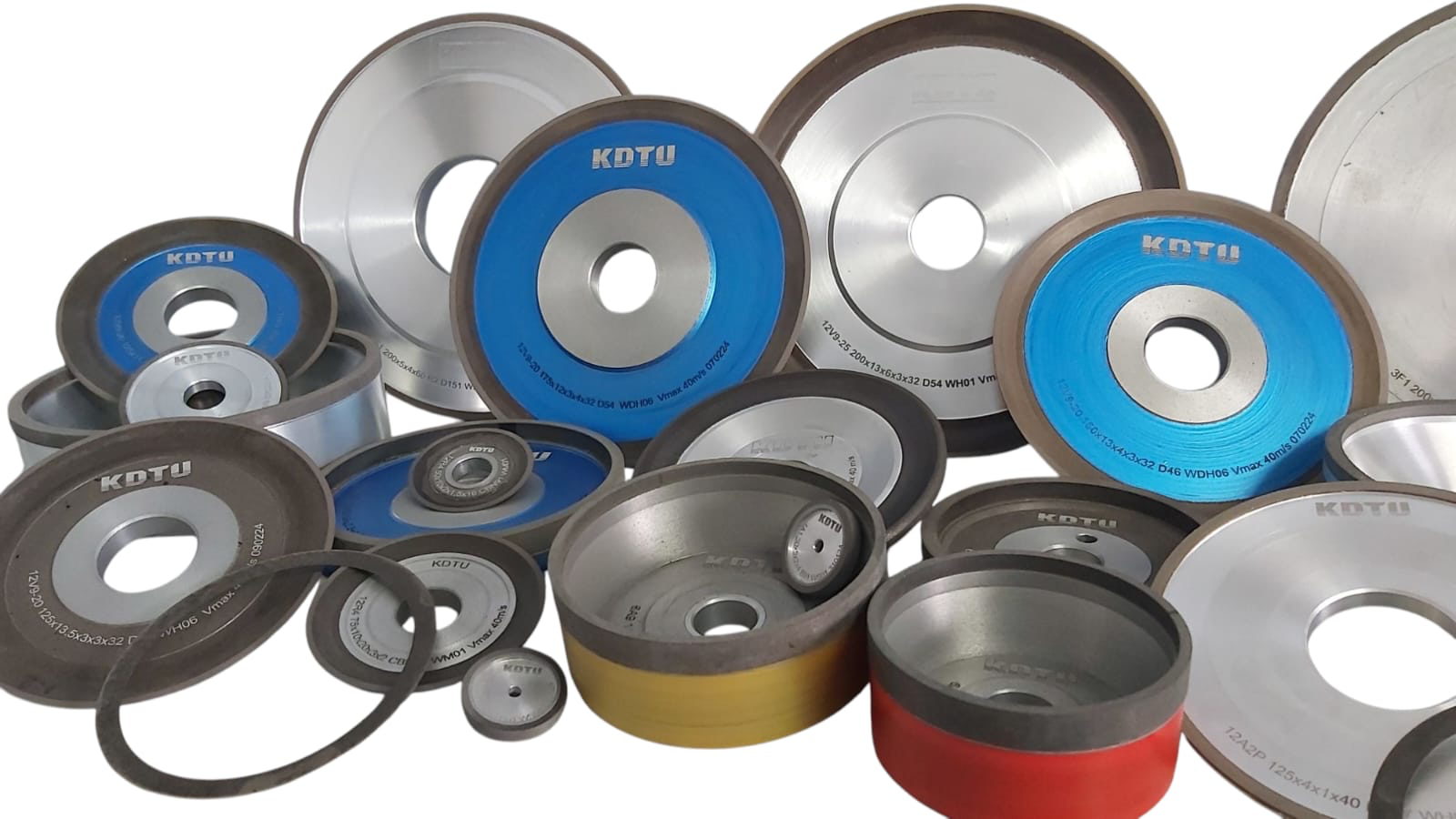
Best quality diamond wheels | KDTU

There are several types of wheels, and they are divided depending on where they need to be used and what type of work needs to be done. The following types are most often used in woodworking.

Diamond grinding wheels. It is clear from the name that this type is used for grinding surfaces. We are talking about fine grinding of wood, chipboard, plywood, MDF and coated materials. If you work with the tool correctly, you will get an ideal result without overheating the surface to be ground and areas that have not been processed.

Diamond grinding wheels. In woodworking, an important element that can ensure stable and high-quality work with the material is the cutting tool. Sometimes a simple kitchen knife that does not cut vegetables or fruits well causes irritation, and here working with much harder material. Accordingly, diamond grinding wheels are needed to sharpen cutting tools in the form of knives, cutters and saws.

Diamond cutting wheels. It is logical that there should be a wheel that is used for cutting. This type is used for cutting wood, chipboard and laminated surfaces. As a result, when used correctly, you will get a thin and neat cut.

Key advantages of diamond wheels in woodworking

Diamond wheels occupy one of the leading places in such an industry as woodworking. The characteristics that this tool has contributed not only to high-quality processing, but also to overall production productivity. So let’s consider the key advantages to better navigate.

Woodworking tools used in the work process | KDTU

High wear resistance and service life

  • As we mentioned earlier, the tool coating consists of diamond grain, either artificial or natural. Today, this is the hardest material known to man. Accordingly, diamond discs wear out more slowly than traditional abrasive tools. If compared to conventional wheels, the service life is several times longer.

Processing quality

  • Thanks to the wheel coating, specialists are able to evenly and accurately remove the desired layer from the surface of the wood. This plays a critically important role when working with expensive materials, or when maximum accuracy is required. As a result, you will get a smooth surface without burrs, chips or traces of overheating.

Working speed

  • Since the diamond tool has a hard coating, the material removal process occurs efficiently and quickly, even with minimal pressure. This increases production productivity, and you can also offer the client the opportunity to process hard woods and other materials. You will quickly achieve the desired result with fewer tool applications.

Stability of work

  • Diamond wheels have good thermal conductivity and work with minimal friction. Thus, the risk of overheating of the wood, which can cause further problems with the material, is reduced. The properties of the wood are preserved, without changing its structure or natural color. Agree, when buying a table or other interior item made of expensive wood for your home, you want everything to be perfect.

Choose diamond wheels for woodworking from KYOTO DIAMOND TOOLS UKRAINE

Diamond blades for the woodworking industry | KDTU

Diamond wheels are an indispensable tool in the woodworking industry, without which it is difficult to imagine the work of both an entire enterprise and local manufacturers. Due to their advantages, the wheels do not lose popularity, and the demand for them is only growing rapidly. Yes, they are more expensive than a traditional tool, but it is completely justified!

If you are looking for a diamond wheel for woodworking, then we invite you to familiarize yourself with our assortment on the website. We offer only high-quality products that are distinguished by their wear resistance and durability. Contact us at +38 050 889 82 89 or kdtu-1@ukr.net. Our specialists will help you with the choice and answer all your questions.

Follow us on Instagram and Facebook

What are diamond and CBN pastes?

The quality of surface treatment of parts that we subsequently use in many areas of our lives plays an important role in industry and various technical aspects. We want to say that it is this process that determines the wear resistance, durability and appearance of products that we can later purchase and use. To achieve perfect smoothness and cleanliness of the surface, specialists use abrasive materials. Most likely, you have already heard about them somewhere, and maybe even used them, just did not pay attention. Among them, one of the leading places is occupied by diamond and CBN pastes.

The most effective tool for grinding, finishing and polishing, which has not lost its popularity and relevance for many years. Further, in this article we will tell you what CBN and diamond pastes are, so that you better understand which paste you may need.

Diamond paste – what is it?
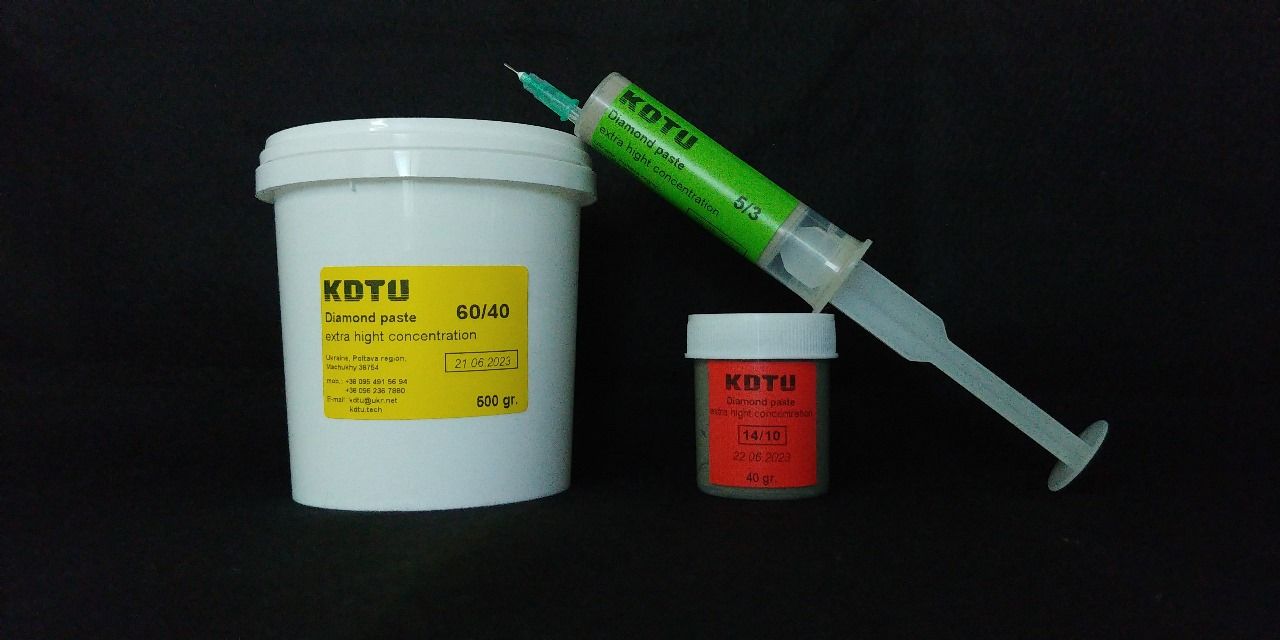
High-acid pastes for grinding and polishing | KDTU

An abrasive mixture consisting of finely dispersed diamond grains and, usually, a viscous base is called – diamond paste. The base is usually water, oil, or mixed. In general, the paste is a mixture that people use to polish smooth surfaces and sharpen metal blades. If you were wondering why the paste polishes so gently, then we have the answer for you. Finely dispersed diamond powder is combined with an abrasive inside the paste. It is he who gives such a cool effect. As for the use, everything is simple here – metal surfaces, ceramic products, glass and other mineral products.

We also want to emphasize that the paste can not only polish and grind. It also cleans the surfaces of the materials that were mentioned above. Small grains cope well with this task.

Advantages of this super paste:

  1. Are you racking your brains on how to polish a surface of a non-standard shape or size and are already halfway there, giving up? Don’t worry, because this paste will easily solve this problem.
  2. Do you want to polish hard-to-reach surfaces, but are tired of searching for the perfect tool for this – you have come across our article in time. Thanks to the liquid composition of the diamond paste, you will be able to achieve an amazing result, namely a smooth and even coating over the entire surface.
  3. The consistency of the paste will also surprise you, because it helps to smooth out all scratches and achieve the best result.
  4. The paste is convenient to use on hardened steel, stainless steel or even titanium parts – the result is always stable. Believe me, we know what we are talking about.

CBN pastes – what is it?
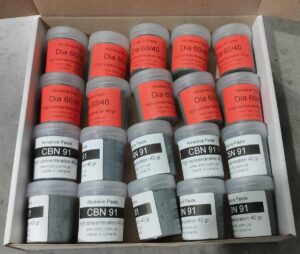
CBN and diamond jaws for surface polishing | KDTU

An abrasive mixture that includes CBN (cubic boron nitride) is CBN paste, which is logical in principle. CBN is the main grinding component, which is a synthetic material. An interesting fact is that this component was created specifically for industrial purposes. It has such properties as high resistance, excellent heat resistance and chemical inertness to iron-containing materials.

If we talk about hardness, then CBN is second only to diamond. But this paste has unique properties that make it indispensable for processing super hard metals, especially at high temperatures. It is widely used for finishing, fine grinding and polishing. We are talking about such materials as high-hardness tool steels, hardened steels and iron-based alloys, nickel, cobalt alloys, ceramics, carbides and ferritic materials. CBN paste is especially important where the processing temperature may exceed the thermal resistance limits of diamond, or in cases where diamond enters into a chemical reaction with the material being processed.

Advantages of CBN pastes:

  1. The first advantage will be the high efficiency of processing hard materials. CBN does not wear out very quickly, so you have the opportunity to work longer and with better results.
  2. The next, no less significant, advantage is heat resistance. The paste does not lose its abrasive properties at high temperatures, which plays an important role in the processing of hardened steels.
  3. The paste copes with its task well, so you will get a well-polished surface at the output.

Diamond and CBN pastes – key differences
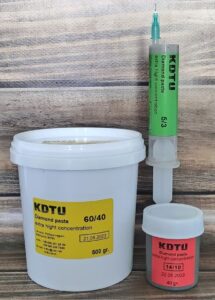
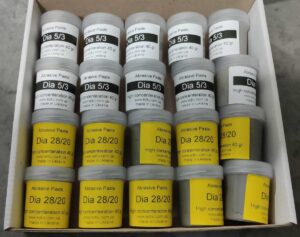
CBN is the mouth and diamond mouth of our production | KDTU

And here the question arises – which paste to choose? Diamond or CBN? They are both great, but it all depends on what exactly you are working with. These pastes are the two most common types of abrasives used for grinding, finishing and polishing various materials. Both types are endowed with their own unique properties, which make them very necessary and popular. So let’s consider the differences between them in order to be able to make the right choice.

Diamond pastes are based on natural or synthetic diamond, which is currently the hardest known material. With their help, you can perform extremely fine polishing with a high degree of surface cleanliness. Due to its hardness, diamond paste is perfect for processing hard surfaces. We are talking about glass, ceramics, carbides, stones, non-ferrous metals. These pastes are often used in jewelry, the optical industry and in the manufacture of micro-tools. However, there are some limitations, as diamond is prone to chemical reactions with certain materials and does not tolerate very high temperatures well.

CBN pastes are based on cubic boron nitride, which is inferior in hardness to diamond, and has higher heat resistance and chemical stability. CBN does not react with iron and retains its abrasive properties at high temperatures. This makes it an excellent choice for processing hardened steels, tool alloys, HSS, heat-resistant nickel and cobalt alloys.

There are also some differences in the polishing quality provided by the two types of pastes. Diamond pastes are able to provide a mirror finish, while CBN pastes are more focused on technical results. Yes, they may be slightly inferior in shine, but they guarantee stability and high precision during processing.

Choose diamond and CBN pastes from a reliable manufacturer
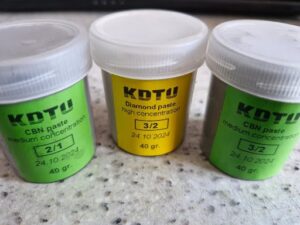
High acidity jaws for various robots | KDTU

Diamond and CBN pastes are indispensable tools in the field of high-precision surface treatment, which allow you to achieve exceptional grinding and polishing quality. If you are looking for a proven polishing agent, we have several options that have proven themselves in working with even the most demanding materials. If you still have questions, please contact us at +38 050 889 82 89 or kdtu-1@ukr.net. Our specialists will be happy to provide you with all the necessary information and help you with the choice, because we want every customer to receive the best product.

Follow us on Instagram and Facebook