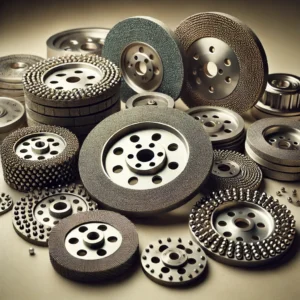
Catalog
UARUEN
MENU
MENU
Catalog

Types of Bonds Used in the Manufacture of Knife Sharpening Stones

Introduction

Виды связок при изготовлении брусков для заточки ножей

Our company started the production of abrasive stones at the request of one of our clients. As you know, earlier we manufactured exclusively professional and specialized tools, mainly for the machine-building and woodworking industries. These were tools for CNC machines for producing carbide cutting tools, for sharpening industrial steel knives, and for many other specific grinding applications.

As a result, the task was set — to create sharpening stones that could compete in quality with well-known manufacturers. One of the main requirements was to study the properties of natural stones and the sharpening mechanics used by traditional craftsmen.

Based on this, we studied the structure, chemical composition, and mechanical properties of natural stones. We then tried to reproduce their analogs, but manufactured using modern materials and production methods applied in machine-building and woodworking.

Structure of the Abrasive Layer

In our stones we use different types of abrasive fillers. But the main ones, without a doubt, are diamond and cubic boron nitride (CBN or Elbor). The correct proportion of these components and bonding agents creates favorable conditions for sharpening different types of steels.

As is well known, the main grinding element — you have probably guessed — is either diamond or CBN. As a rule, we prefer to use CBN, since it is specifically intended for steel processing.

CBN has a crystal shape similar to natural abrasives, but in an enlarged size. In combination with secondary polishing fillers, CBN makes it possible to work with steels of any hardness. Moreover, it does not tear the cutting edge. Instead, it leaves the most uniform scratches (grooves formed after material displacement by CBN crystals).

​Comparison of Bond Types: Metallic, Organic, and Hybrid

Hybrid bonds demonstrate high performance, even in comparison with metallic bonds. In particular, with tin-copper types such as M2-01 (commonly called Bronze) or aluminum-based bonds such as M1-01 (also known as Silver). The wear resistance of a hybrid bond is not inferior to that of M1-01 bonds. Moreover, it is four times more durable than organic bonds such as phenol-formaldehyde resin or epoxy resin.

For reference, in the production of diamond tools for industrial enterprises, bonds are usually divided into two main groups: metallic and organic.
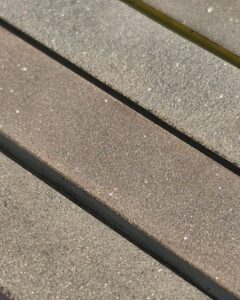
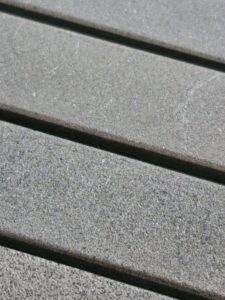
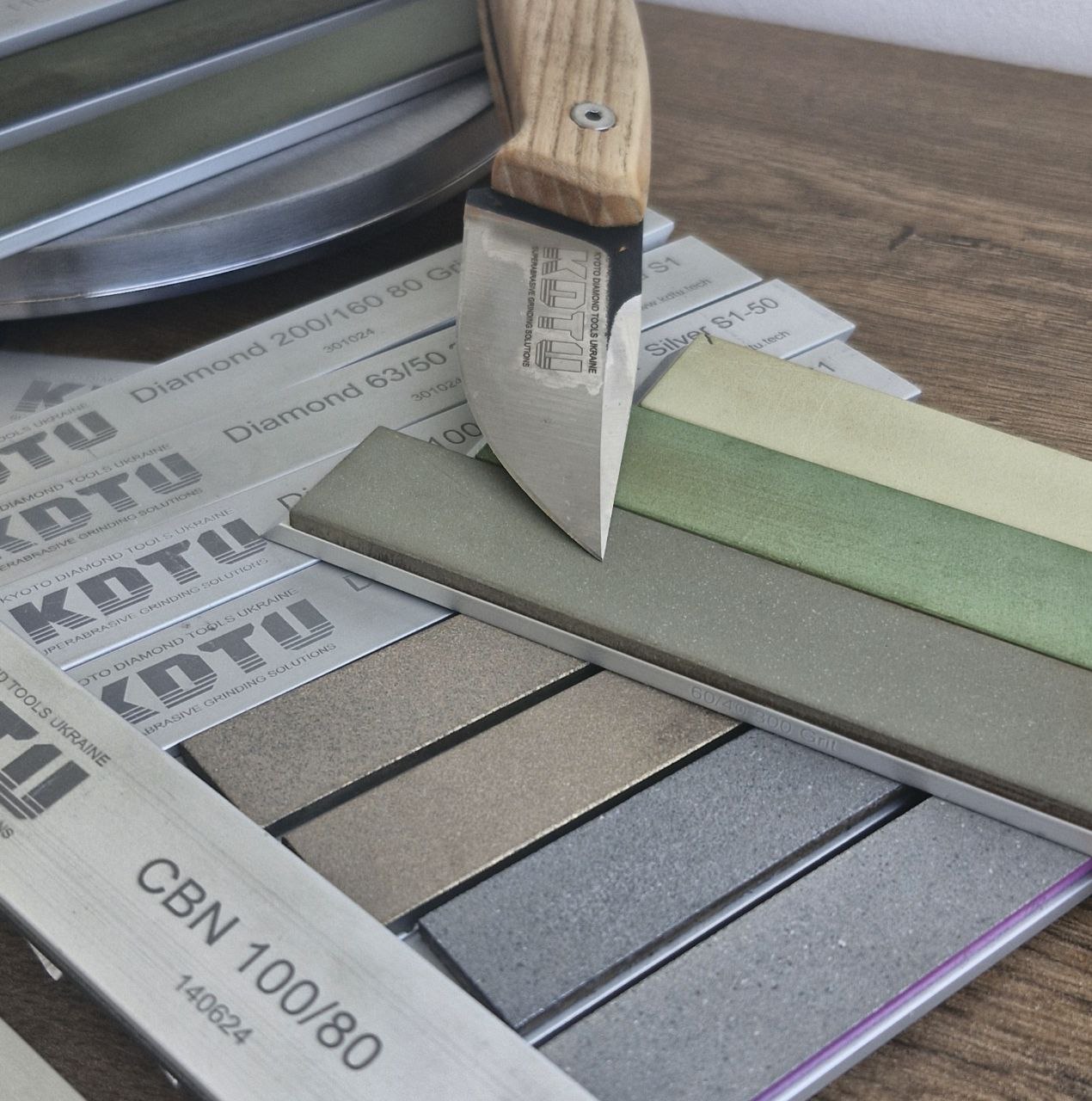
Бруски на медной связке М2-01 типа Gold KDTUСвязка М1-01 типа Silver

A bond is the binding substance that holds the abrasive grains on the working surface of the tool. Metallic bonds, in turn, are divided into two types.

Metallic Bonds

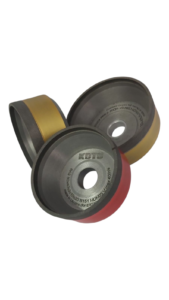
  • M2-01: based on copper and tin with the addition of tungsten, cobalt, nickel, and iron. It has a yellowish color. This is probably the hardest and most durable bond, capable of holding high-strength diamonds. Therefore, it is mainly used for processing glass, stone, and ceramics.
  • M1-01: aluminum-zinc with a small addition of copper. This bond is very complex and more expensive to manufacture. Since it is softer than M2-01, it has not become as popular. Its primary purpose is the processing of hard alloys.

Organic Bonds

Organic bonds are binders where the bonding element of the abrasives in the working layer is resin (an organic compound). It may differ in composition and name. As a result, the quality of the resin determines the ability to hold superabrasives on the surface.

This is the most common bond, which was the first to be applied in the production of diamond and CBN stones. In mechanical engineering, they are designated as B2-01 and B1-01.

  • B2-01 — pure phenolic resin, black or dark gray in color.

  • B1-01 — resin bond with added copper for higher loads and better heat dissipation from the grinding zone; has a reddish tint.

These are soft bonds. As is well known, they are not capable of holding strong diamonds, similar to the M2-01 bond.

Hybrid Bonds
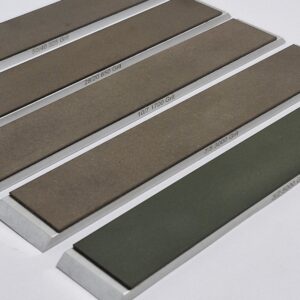
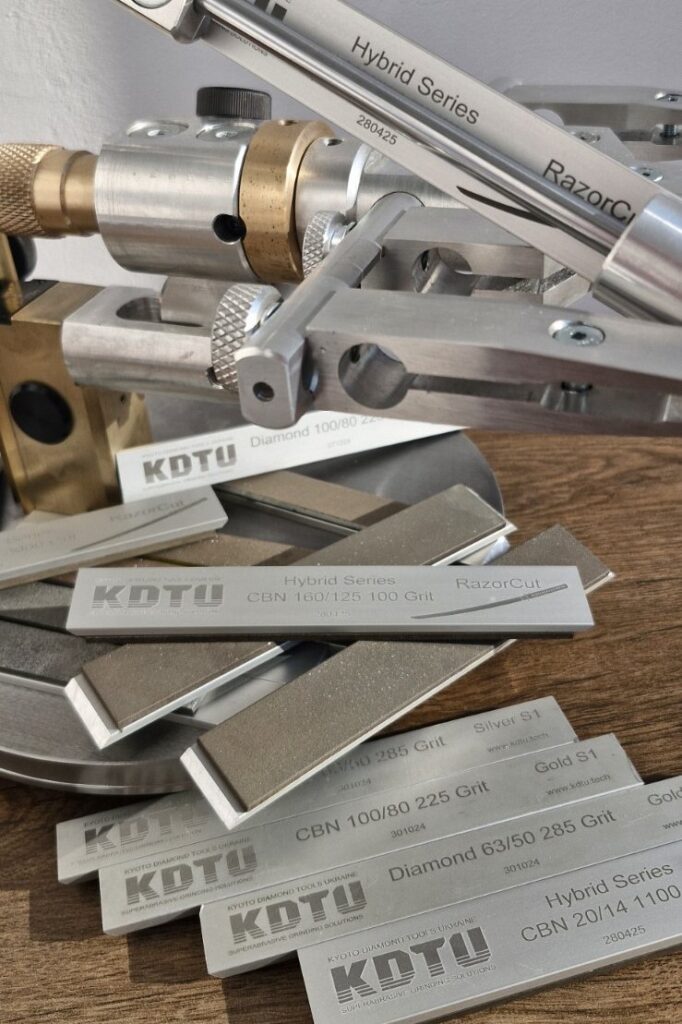
Бруски на гибридной связке

Hybrid bonds are the latest developments based on modern resins. Without a doubt, they differ from standard phenolic resins by their high strength, and therefore they are capable of holding diamonds, just like M2-01 and its varieties.

The huge advantage of hybrid bonds lies not only in their increased durability and performance but also, without question, in ease of use.

Stones can generally be used without lubricating fluids, or they can be wetted with water, oil, or soap. In any case, the result will always be excellent. Hybrid bonds do not strain the hand during sharpening, unlike metallic bonds.

Stones are very easy to dress. The dressing process is the same as with stones on organic bonds. Hybrid bonds have good self-dressing properties (the self-exposure of diamond or CBN crystals due to friction against steel). They do not need frequent dressing on glass (or a lapping plate).

The self-dressing process can be observed during sharpening: fine dark dust is formed along with steel shavings. But this does not mean that the stone wears quickly. The abrasive grains are held strongly in the bond. The stone confidently maintains a flat working surface.

As practice has shown, a single stone can sharpen about 200 knives of various steels — from soft stainless steel to hard steels over 60 HRC, without any signs of “saddle” on the surface.

Essentially, a hybrid bond is a universal bond for all types of steel.

In metalworking, there is a fundamental principle:
“Soft is processed with hard, hard is processed with soft.”

In other words, soft steels are best processed with hard copper bonds, and hard steels with soft phenolic bonds. Hybrid bonds occupy a middle position in hardness, thus achieving a “golden ratio” in terms of durability, performance, and edge quality.


Purpose of Hybrid Bonds

We offer our clients several types of stones with different abrasive layer properties:

  • Traditional hybrid bond, which has moderate material removal intensity. At the same time, this bond allows excellent control over the sharpening process even for the most capricious powdered, brittle, and crumbly steels.

  • Bond with increased abrasiveness (or increased material removal intensity). Usually recommended for use with coarse and medium grit when very fast sharpening or significant correction of the knife edge is needed. But even with fine CBN grits, it will handle its task well without creating separate deep scratches.

  • Bonds for finishing with especially fine diamond or CBN crystals. We designed these bonds to maximally approximate the sharpening quality of natural or water stones. These bonds contain crystals from 5 to 2 microns. They can sharpen a knife blade almost to a mirror finish without damaging carbides in particularly hard steels. The knife’s cutting ability is preserved.

  • Bond for more decorative sharpening with crystals smaller than 0.3 microns. This bond allows obtaining a fully mirror surface on the knife blade. With such stones, one can completely replace polishing with abrasive pastes.

Despite the popularity of hybrid bonds, we can offer stones on metallic bonds of our Gold and Silver series. These bonds are for lovers and connoisseurs of classic stones on metallic binders.

Stone Maintenance

During use, stones have the property of clogging with steel shavings, which affects the speed of the stone. The fastest way to clean the stone is to apply a little oil to its surface and wipe across the entire plane. You will see how all the slurry quickly appears on the surface. It is very easy to wipe off with a napkin or any cloth. Thoroughly wipe the stone, and you can confidently continue working.

After work, the stone should be well washed in water with soap and placed back in the box for storage.

How to Assemble a Set of Stones
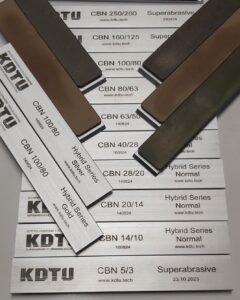
Разновидность брусков на гибридной связке

Variety of stones on hybrid bonds

To choose a set of stones, you first need to understand what knives you will work with and what budget you are counting on.

If you plan to work with all types of knives, with various serious damages, or sharpen blanks from scratch to a mirror finish, you will need a full set of stones starting from:

  • Roughing: 315/250; 250/200; 200/160; 160/125; 125/100

  • Middle stage: 100/80; 80/63; 63/50; 50/40; 40/28

  • Finishing: 28/20; 20/14; 14/10; 10/7

  • Polishing, which starts giving a mirror effect: 7/5; 5/3; 3/2; 2/1

If a cleaner finish is needed, lapping stones with pastes, emulsions, and natural stones are used.

Sets are usually formed from one or two roughing stones, and then middle and finishing stages are selected in one-step intervals, e.g., after 100/80 or 80/63, then 50/40 or 40/28.

For hunting knives working in harsh conditions, it is enough to choose a set ending with grit 28/20 or 20/14. If you still want a slight mirror shine, you can finish with 10/7. After that, it is not necessary. The first contact with bone or another hard object will scratch the knife, and on a perfectly mirror surface, it will be very noticeable.

Do not forget that sharpening stones must form a clearly defined uniform micro-serration on the knife edge, which affects the aggressiveness of cutting rough materials and the durability of the cutting edge. At the same time, it is necessary to correctly select the sharpening angle for each type of knife.

For beginners who want to sharpen kitchen or tourist knives, it is recommended to start with one or two stones with grits 50/40 and 28/20. You can start without a machine.

From budget options, our company can offer stones from the professional line with a working layer thickness of 1 mm.

If you have any questions, contact us at +38 050 889 82 89 or kdtu-1@ukr.net. We will be happy to answer all questions and help with selection.

This article is also available in RU and UA.
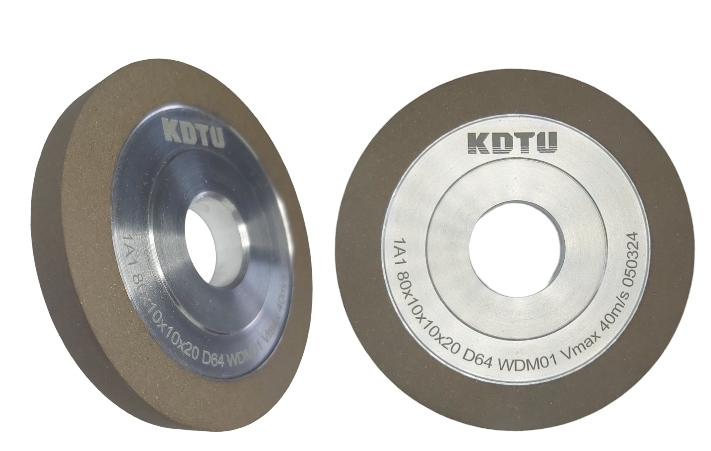
Abrasive: common mistakes when working with the tool

Working with abrasives is not just a technique, it is a strategy. There are many types of abrasives on the market today. These range from conventional corundum to super abrasives. Super abrasives include diamond and cubic boron nitride. Cubic boron nitride is also known as CBN (cubic boron nitride), elbor, or cubanite. Over the years of practice, we have become convinced of one thing. Even small mistakes can turn an expensive set of tools into a pile of unnecessary iron. Below, we will tell you what kind of abrasive to choose to make your work productive. We will also explain what to avoid. This is to ensure the tool you choose does not become a waste of money.

Abrasives: types and uses

Until people invented a way to manufacture synthetic diamond on an industrial scale, the main abrasive material for grinding carbide and various steels was white aluminum oxide, green silicon carbide, boron carbide and some other types of abrasive.

Over time, toolmaking required greater resistance to wear and tear, and a longer life for the sharpness of the tool’s cutting surface. To do this, it was necessary to invent harder steel grades that became more difficult to process with conventional abrasives.

Diamond tools have become a reliable assistant for grinding operations in the machine building and tool industry.

Abrasive for metal polishing | KDTU

Diamond is the hardest material that exists in nature, so it has greatly facilitated and accelerated the processing of such materials as hard alloy, ceramics, glass, and stone.

But it could not cope with grinding steel. Diamond is synthesized from quartzite-like graphite under high pressure and temperature. Iron is used as a catalyst for the transformation of graphite into diamond.

Therefore, when materials are processed at high speeds, high temperatures are generated in the grinding zone, which, in contact with iron, lead to reverse processes and turn diamond back into graphite.

For these purposes, another super abrasive was synthesized — cubic boron nitride (CBN), which is slightly inferior in hardness to diamond, but can withstand higher temperatures and is inert to iron.

We will discuss it in more detail.

Advantages of CBN over conventional abrasives

The most common material for machining steels is an abrasive. It does an excellent job. However, issues arise when working with unalloyed steels, bearing steels, heat-treated steels, heat-resistant steels, and titanium alloys. These materials have a hardness of more than 55HRC. This is where the problems for manufacturers begin. The part needs to be manufactured quickly to reduce product costs. This is necessary to maintain competitiveness through mass production. However, even the hardest abrasives can only remove 0.5 microns (or microns) of material on such steels. In contrast, CBN can remove from 0.01 mm to 0.1 mm in one pass. This process does not disturb the steel structure.

Abrasive polishing tool | KDTU

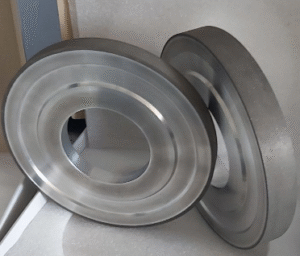
CBN abrasive discs have a lifetime that is hundreds of times longer than the toughest abrasives. And another advantage of CBN tools that our customers have noted is the absence of dust during dry grinding.

Imagine an abrasive wheel. Its diameter is 200 mm or 400 mm. The width is 10 mm or 40 mm. It wears down into dust. This dust disperses throughout the shop. Workers breathe it in.

When grinding with coolant, the dust turns into sludge. This sludge contaminates the machine, coolant, and fluid filters. As a result, related materials need replacement faster.

CBN is also unique in that, unlike conventional abrasives, it can work without cooling without burning the surface of the workpiece. However, this requires the proper selection of the CBN grinding wheel parameters, dimensions, and operating conditions.

CBN on steel does not work

Unfortunately, we often encounter the problem of customers’ distrust of CBN wheels. Many have already tried to replace abrasives in order to speed up the grinding process. They faced the issue of inefficient operation of the super abrasive — seizing the wheel, burning the surface to be processed, or wearing out much faster than a conventional abrasive. And the customer comes to the conclusion that CBN on steel does not work. Yes, such an issue exists if the manufacturer of the CBN tool does not know all the secrets of making a bond for grinding steel. A bond is a multi-component resin-based composition that contains super abrasive powder. Each of these components affects the hardness of the grinding wheel and the ability to recover the working grains, which in turn affects the result of the workpiece processing.

Tips for selecting the right CBN discs

When making the switch from conventional abrasives to CBN abrasive discs, it is important to consider some factors below.

Motor strength

As a rule, small machines for grinding furniture knives are equipped with low-powered motors. Since the abrasive has a much lower hardness and performance, the machine can cope with its task. The main mistake made when switching to CBN wheels is that customers ask for the same working surface parameters as for conventional abrasives. This results in the machine becoming noisy. The surface of the workpiece burns. Additionally, the machine cannot provide the necessary spindle speed. The spindle speed is required for the grinding wheel mounted on it.

CBN works more aggressively and penetrates deeper into the steel surface than conventional abrasive. The super abrasive grain does not crumble like a conventional abrasive. To ensure normal operation, the contact area must be reduced. This is achieved by narrowing the width of the CBN tool by 1.5–2 times.

Speed of rotation

CBN requires a sufficient speed. The optimum value ranges from 2500 to 3500 rpm, depending on the diameter of the abrasive wheel. As a rule, they operate at a minimum speed, so machines for them are made with a speed of 1500 rpm. This is especially true for surface grinding wheels with diameters ranging from 250 mm to 350 mm or 400 mm and above. KDTU was able to select the necessary bonding parameters that ensure the operation of CBN wheels at a minimum speed of 1500 rpm. However, it should be understood that at such speeds, abrasive wheels made by other manufacturers may no longer work.

When selecting CBN wheels for flat grinding, where wheels with a diameter of 350-500 mm and a width of 40-60 mm or 80 mm are usually used, it is necessary to select a CBN wheel with a width 2.5-3 times smaller.

It should also be understood that an abrasive wheel with a diameter of, for example, 500 mm can be worn down to a diameter of 250 mm. Therefore, a CBN wheel can be manufactured in the middle range, i.e., around 350 mm.

Abrasive grains

As a rule, abrasive wheels for grinding are made with large abrasive grains of the F40 or F46 order, which corresponds to an average size in microns of 438 microns and 370 microns. It should be borne in mind that an abrasive wheel with the specified parameters for removing 1 micron of material from a workpiece will actually remove 0.5 microns. This is because the abrasive grain crumbles to a size approximately half that. To 220 microns and 180 microns, respectively. Therefore, the size of the CBN abrasive must be selected with this effect in mind and should be between 250 microns and 200 microns.

Abrasive and its hardness

And the last point, all conventional abrasives are divided by hardness: very soft (F, G), soft (H, I, J), medium (M, N), hard (R, S), and others. All of this depends on the abrasive they are made of, whether it is aluminum oxide, silicon carbide, or titanium. Therefore, the main criteria for selecting a super abrasive wheel over a conventional abrasive are the grain size and the bond characteristics. These are selected according to the operating conditions. Sometimes it takes two or three attempts to find the optimum characteristics of a CBN wheel for maximum performance and maximum durability. As a rule, we first offer a fairly soft bond that will work regardless of the operating conditions of the wheel. Then, at the customer’s request, the bond density or grit can be increased or decreased until the desired result is achieved.

Abrasive: proper use

Grinding wheel for large production | KDTU

The main condition for high-quality and long-lasting operation of grinding wheels is compliance with the operating conditions. Sometimes, in the pursuit of quick results, operators deliberately overestimate the depth of material removal per pass or the feed rate. Less often, they overestimate the spindle speed. This leads to increased loads on the wheel. As a result, it causes rapid abrasion of the wheel at best. Or it leads to its destruction. Under heavy loads, not only does the load on the abrasive grains increase. The temperature in the grinding zone also rises. This causes the chemical composition of the bond or adhesive to lose its properties. The bond or adhesive holds the bond to the aluminum or steel body. As a result, the working layer of the abrasive tears away from the body.

It is not advisable to constantly remove and reassemble the abrasive disc from one machine to another. This is especially true when the discs are large. This causes the disc to “beat” on the machine and requires time to adjust to the newly installed machine.

We do not recommend modifying grinding wheels by yourself with different grinds of the body or the hole, as this can lead to an imbalance of the wheel and a deterioration in its performance or destruction.

Another important thing to keep in mind is that overdrive modes can increase performance but decrease the wheel’s durability. Therefore, the operator must clearly understand what is more significant to him — either the long life of the tool or high performance at the expense of stability.

Final thought

Working with abrasive tools is all about math: precision + discipline = results. Don’t believe me? If you cut porcelain with a diamond sharpening blade, you’ll spend an hour instead of minutes and end up with crooked edges. If you save money on glasses, you’ll visit a doctor, who will remind you that “cheap” sometimes costs too much.

Your toolkit is an investment. Take care of it, use it wisely, and it will serve you for a long time. And remember: the best tool without knowledge is a piece of metal. Learn, analyze your mistakes, and then even diamond wheels will become not just “disks” for you, but an extension of your professional intuition.

To order abrasive tools, please contact us at +38 050 889 82 89 or send an e-mail to kdtu-1@ukr.net. Our experts will help you with the selection and answer any questions you may have.

We do not sell abrasive discs. We are selling you the economic benefits that you will gain from working with our tools. Sometimes people say that wheels are expensive. When comparing our competitors’ offer with ours, we always calculate what benefits our customer will get. Either he wins on the purchase price, or they get a tool that works, for example, 4 times longer and costs half as much. A more expensive tool with better work quality ultimately yields economic benefits through significantly longer work, reduced equipment downtime due to time saved on re-installing and tooling, and higher productivity per hour of work.

With a more expensive tool, you will be able to produce more products per hour, thus covering your costs for purchased tools, increasing the output of your finished products, which can cost more per unit than a grinding wheel.

Follow us on Instagram and Facebook

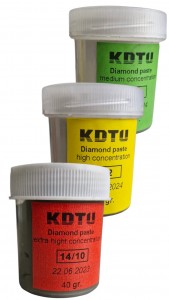
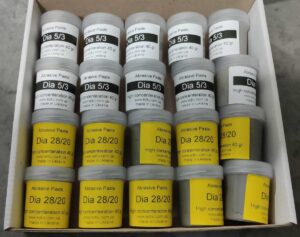
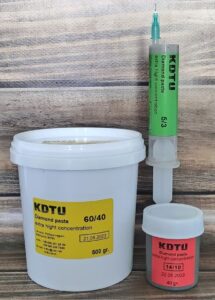
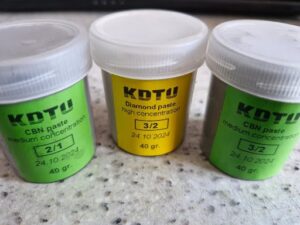
How to choose diamond or CBN paste — practical tips

Let’s cut through the noise: when you’re grinding, polishing, or finishing metals, ceramics, or other stubborn materials, that mirror-smooth surface finish isn’t just luck—it’s about using the right abrasive paste. But here’s the kicker — choosing between diamond and CBN paste can still feel like a head-scratcher, even for seasoned pros.

Why? Because both pack serious power, but they’re not interchangeable. Get this right, and you’ll slice through production bottlenecks. Get it wrong, and you’re flushing time and money down the drain.

In this no-BS guide, we’re breaking down the nitty-gritty details most suppliers won’t tell you: what really matters when deciding between these two heavy hitters, how to match grit sizes and binders to your exact needs, and — most importantly — how to dodge those expensive rookie mistakes that sabotage surface quality. Let’s dive in.

Diamond vs CBN paste: the key to flawless machining

CBN polishing paste | KDTU

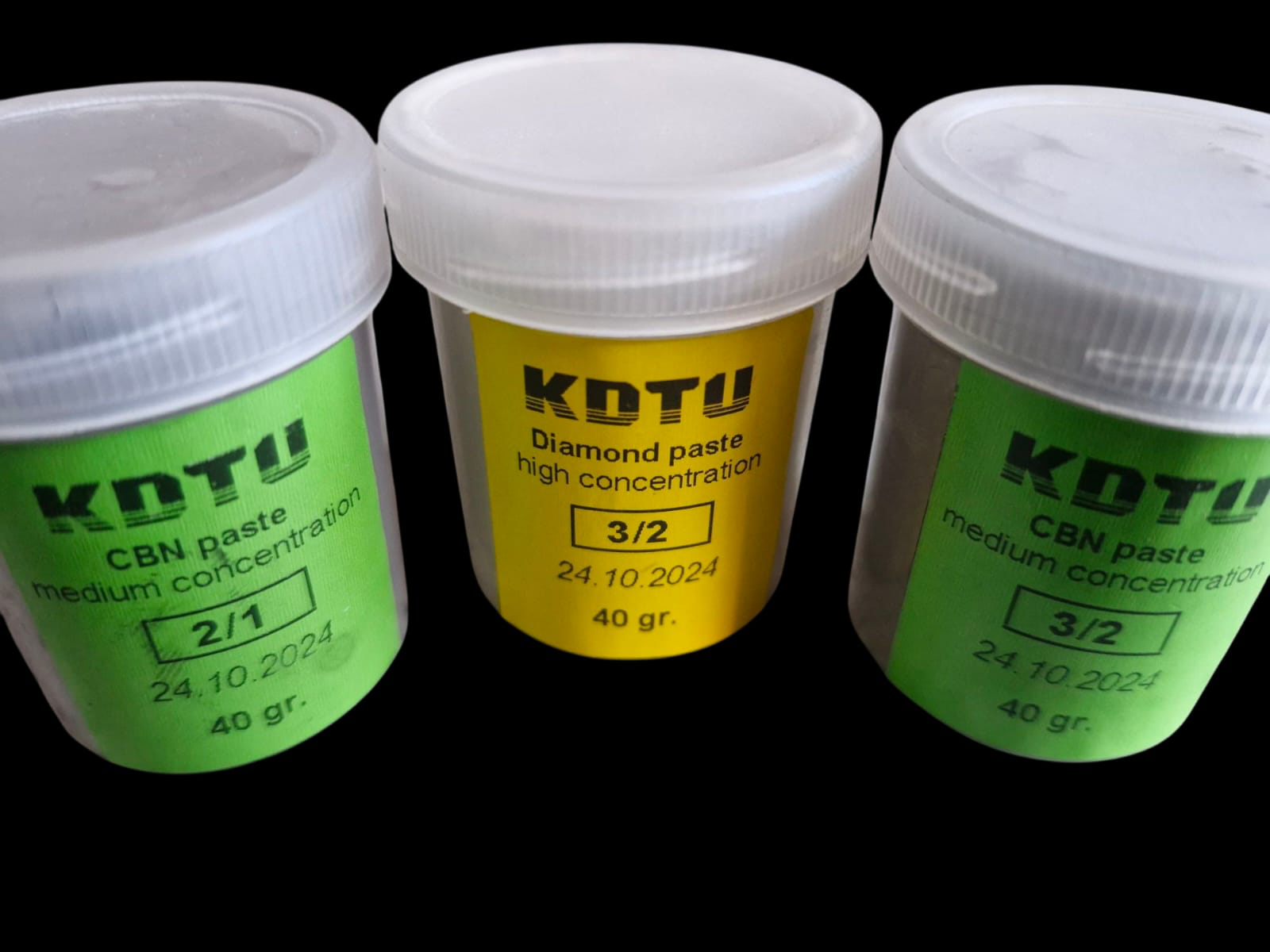
Diamond paste is a powerful tool made of microscopic diamond crystals that work as a precise “scalpel” for the surface. Its secret is its extreme abrasiveness, which makes it ideal for polishing the hardest materials: carbide, glass, ceramics. Imagine a tool that doesn’t just grind, but literally cuts away micro irregularities, leaving the surface flawless.

CBN (cubic boron nitride) paste is a technological trump card for metals that are “afraid” of temperature. Its particles are 20% softer than diamond particles, but this is what makes it the perfect helper for high-alloy steels, titanium or heat-resistant alloys. If diamond is the “impact force”, CBN is the strategy: it gently removes defects, avoiding overheating and preserving the structure of the material.

Grit: from brute force to jewel-like precision

Diamond paste comes in different types:

  • 40-50 microns — for fighting deep scratches (like a “heavy machine gun” in the world of abrasives);
  • 0,1-1 microns — for finishing gloss, where every micron determines the quality (like an artist’s brush).

CBN pastes also offer different gradations, but their advantage is heat resistance. Even during prolonged contact, they:

  • Do not melt the surface;
  • Do not deform, remaining stable at temperatures up to +300°C.

Important!

Diamond abrasives sometimes “mask” the problem: they close micropores on steel, creating the illusion of smoothness. CBN pastes work differently — they cut out defects without leaving marks, thanks to their controlled aggressiveness.
For copper, aluminum and other materials with high thermal conductivity:

  • Diamond polishing paste is suitable — its formula minimizes heat;
  • Not suitable to CBN for thin-walled parts — the risk of deformation increases many times.

To summarize:

  • Diamond paste is the “king” for carbide, ceramics, glass.
  • CBN paste is the “savior” for steels and titanium.

Choose wisely and your surface will shine like a mirror! And if in doubt, KDTU LLC experts will help you find the perfect balance between performance and efficiency.

Diamond paste classification and key parameters

Before buying diamond paste, it is significant to understand its classification. The main parameters are:

  • The composition of diamond paste: the base (often oil or water) and the concentration of diamond powder.
  • Granularity (FEPA or GOST).
  • Purpose: for example, diamond paste for galvanizing laps is different from diamond paste for hand polishing.

If the diamond polishing paste has a fine grit (less than 5 microns), it is recommended to use it in the final stages when micro irregularities need to be removed. Coarser variants (20-40 microns) are effective for removing deep scratches.

Extras:

  • Oil base provides better tool grip and longer life.
  • Water base is suitable for automated systems with coolant supply.
  • For jewelry or optics, pastes with added wax are used to prevent damage to fragile surfaces.

When to choose CBN paste?

Diamond polishing paste | KDTU

CBN paste is a modern alternative to diamond abrasives. Its main advantage is its ability to work on materials that are highly viscous or prone to sticking. For example, when machining stainless steel or heat-resistant alloys, CBN pastes reduce the risk of burr formation.

Scope of CBN applications:

  • Machining of steel workpieces in aircraft construction.
  • Finish polishing of TiN (titanium nitride) coated tools.
  • Working with materials where overheating is critical (e.g., precision engine parts).

It is also important to consider the economic aspect. While diamond pastes are typically less expensive, CBN can be more cost-effective due to its longer life when working on certain materials. For example, one pack of 10 µm CBN paste can replace 2-3 packs of diamond paste due to less wear.

Practical recommendations from KDTU LLC: how to avoid mistakes and achieve perfect results

  1. Paste selection for the material: precision is the key to success.
    • Carbide, ceramic, glass? Diamond paste is your choice. Its micron diamond particles will “remove” even the toughest irregularities, leaving the surface as smooth as a mirror.
    • Steel, titanium, heat-resistant alloys? CBN paste rules here. It works more gently, avoiding overheating, and is ideal for ductile metals.
    • Combination materials? Combine! First diamond pastes for roughing, then CBN for a glossy finish.
  2. Grit: Staging is the secret to professional polishing.
    Take your time with fine pastes! Start with 40-50 microns to remove deep scratches. Then move to 3-5 microns — this is the stage where the shine appears. And for a mirror effect, add an aluminum oxide finish.
  3. Paste base: not all mediums are the same.
    • Water-based is for cooled machines. Leaves no film, ideal for automation.
    • Oil base — for custom workshops. Does not dry out, lies perfectly on stamps during manual polishing.
  4. Testing: check before you start — your insurer.
    Before you buy diamond paste in a batch, test it on a “proving ground”:

    • Apply to a test area.
    • Measure the processing time.
    • Make sure the surface is not overheated.
    • Evaluate the result under different light angles.
  5. Storage: where work ends, care begins.
    Even the best quality diamond polishing paste will lose its effectiveness if:

    • The tube stands under the sun — ultraviolet destroys the binding components.
    • The cap is not closed — the base dries out and the particles delaminate.

3 mistakes that negate the result

  1. Diamond paste for steel parts.
    Consequence: abrasive rubs off in 10 minutes, surface burns fingers.
  2. Trying to “jump” through the steps.
    Consequence: thin paste “preserves” scratches — you will have to start over.
  3. “Lots of material means better”.
    Consequence: excess clogs the tool, increases costs by 30%.

Why do customers choose KDTU LLC?

Diamond polishing paste | KDTU

We don’t sell pastes — we sell solutions. Here’s what you get:

  • Quality.
    The goods meet all standards and are of good quality.
  • Paste for your tasks.
    We can find the right paste for any task.
  • Turnkey savings calculation.
    Our managers will tell you how much paste you need for a shop with 1000 parts/day — so you don’t overpay for excess.
  • Diamond and CBN pastes — from 5 microns to 100 microns.
    From roughing to jewelry polishing — all in one line.

Bottom line: your success starts with the right choice of diamond or CBN paste

  • Hard materials? Only diamond paste — it has no rival when working with carbide or ceramics.
  • Metals that are “afraid” of temperature? CBN paste — minimum friction, maximum efficiency.
  • In doubt? Click “Call” — our experts will analyze your case to the last detail.

To order diamond and CBN pastes, please contact us by phone +38 050 889 82 89 or by e-mail kdtu-1@ukr.net. Our specialists will help you with your choice and provide answers to all your questions.

Follow us on Instagram and Facebook.

Diamond wheels for woodworking and their advantages

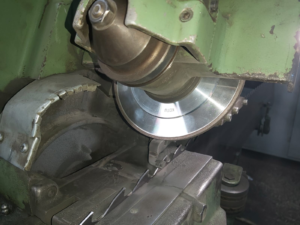
Diamond wheel for woodworking in use | KDTU

Woodworking cannot be called simply a production process, because in its course whole works of art are often created. Agree, it has happened that when you came to visit friends or relatives, you noticed a very beautiful table, or a high-quality countertop. Such details immediately catch the eye and make the design more refined and attractive. However, we want to note that in order to achieve such a result in woodworking, you must use an accurate, high-quality and reliable tool. The choice of tool is important, because not only the final result, but also the entire working process depends on it. Therefore, in this article we want to tell you about diamond wheels for woodworking and their advantages, so that if you have the desire, you yourself can create your own masterpiece from wood.

What are diamond wheels for woodworking?

A tool used for grinding, cutting or sharpening various materials is a diamond wheel. Woodworking tools of this type are made of reliable materials and have a feature in the form of a diamond coating, which allows ensuring the hardness and abrasiveness of the wheel.

Types of diamond wheels

Best quality diamond wheels | KDTU

There are several types of wheels, and they are divided depending on where they need to be used and what type of work needs to be done. The following types are most often used in woodworking.

Diamond grinding wheels. It is clear from the name that this type is used for grinding surfaces. We are talking about fine grinding of wood, chipboard, plywood, MDF and coated materials. If you work with the tool correctly, you will get an ideal result without overheating the surface to be ground and areas that have not been processed.

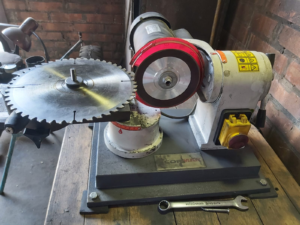
Diamond grinding wheels. In woodworking, an important element that can ensure stable and high-quality work with the material is the cutting tool. Sometimes a simple kitchen knife that does not cut vegetables or fruits well causes irritation, and here working with much harder material. Accordingly, diamond grinding wheels are needed to sharpen cutting tools in the form of knives, cutters and saws.

Diamond cutting wheels. It is logical that there should be a wheel that is used for cutting. This type is used for cutting wood, chipboard and laminated surfaces. As a result, when used correctly, you will get a thin and neat cut.

Key advantages of diamond wheels in woodworking

Diamond wheels occupy one of the leading places in such an industry as woodworking. The characteristics that this tool has contributed not only to high-quality processing, but also to overall production productivity. So let’s consider the key advantages to better navigate.

Woodworking tools used in the work process | KDTU

High wear resistance and service life

  • As we mentioned earlier, the tool coating consists of diamond grain, either artificial or natural. Today, this is the hardest material known to man. Accordingly, diamond discs wear out more slowly than traditional abrasive tools. If compared to conventional wheels, the service life is several times longer.

Processing quality

  • Thanks to the wheel coating, specialists are able to evenly and accurately remove the desired layer from the surface of the wood. This plays a critically important role when working with expensive materials, or when maximum accuracy is required. As a result, you will get a smooth surface without burrs, chips or traces of overheating.

Working speed

  • Since the diamond tool has a hard coating, the material removal process occurs efficiently and quickly, even with minimal pressure. This increases production productivity, and you can also offer the client the opportunity to process hard woods and other materials. You will quickly achieve the desired result with fewer tool applications.

Stability of work

  • Diamond wheels have good thermal conductivity and work with minimal friction. Thus, the risk of overheating of the wood, which can cause further problems with the material, is reduced. The properties of the wood are preserved, without changing its structure or natural color. Agree, when buying a table or other interior item made of expensive wood for your home, you want everything to be perfect.

Choose diamond wheels for woodworking from KYOTO DIAMOND TOOLS UKRAINE

Diamond blades for the woodworking industry | KDTU

Diamond wheels are an indispensable tool in the woodworking industry, without which it is difficult to imagine the work of both an entire enterprise and local manufacturers. Due to their advantages, the wheels do not lose popularity, and the demand for them is only growing rapidly. Yes, they are more expensive than a traditional tool, but it is completely justified!

If you are looking for a diamond wheel for woodworking, then we invite you to familiarize yourself with our assortment on the website. We offer only high-quality products that are distinguished by their wear resistance and durability. Contact us at +38 050 889 82 89 or kdtu-1@ukr.net. Our specialists will help you with the choice and answer all your questions.

Follow us on Instagram and Facebook

What are diamond and CBN pastes?

The quality of surface treatment of parts that we subsequently use in many areas of our lives plays an important role in industry and various technical aspects. We want to say that it is this process that determines the wear resistance, durability and appearance of products that we can later purchase and use. To achieve perfect smoothness and cleanliness of the surface, specialists use abrasive materials. Most likely, you have already heard about them somewhere, and maybe even used them, just did not pay attention. Among them, one of the leading places is occupied by diamond and CBN pastes.

The most effective tool for grinding, finishing and polishing, which has not lost its popularity and relevance for many years. Further, in this article we will tell you what CBN and diamond pastes are, so that you better understand which paste you may need.

Diamond paste – what is it?

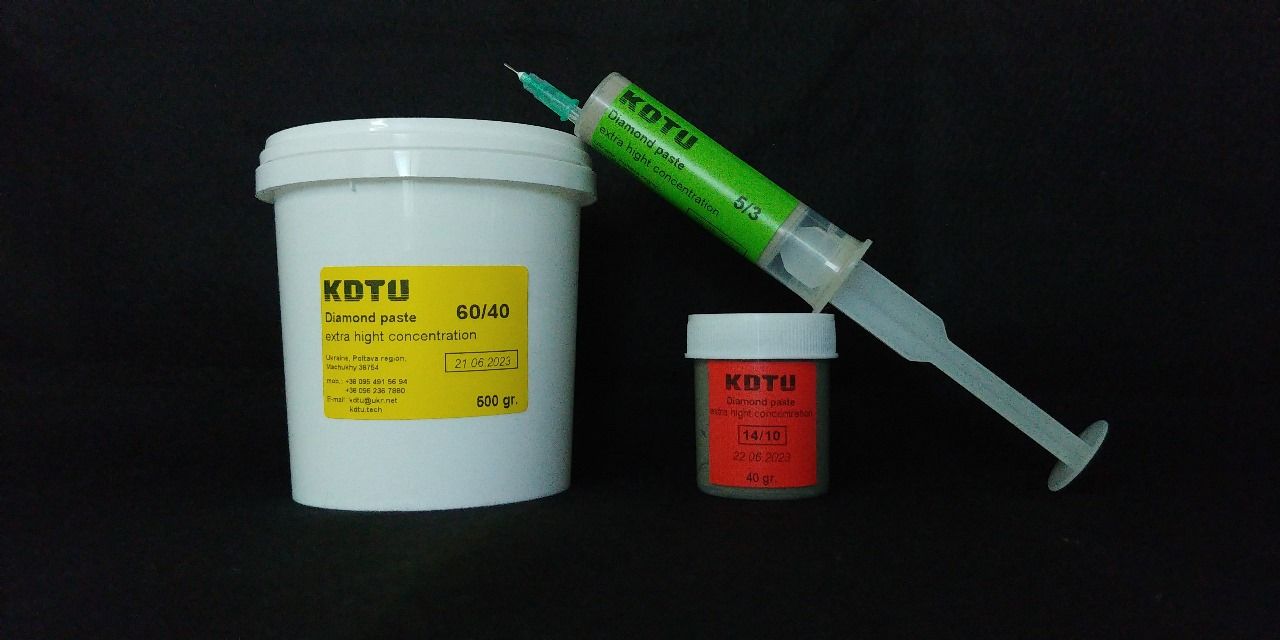
High-acid pastes for grinding and polishing | KDTU

An abrasive mixture consisting of finely dispersed diamond grains and, usually, a viscous base is called – diamond paste. The base is usually water, oil, or mixed. In general, the paste is a mixture that people use to polish smooth surfaces and sharpen metal blades. If you were wondering why the paste polishes so gently, then we have the answer for you. Finely dispersed diamond powder is combined with an abrasive inside the paste. It is he who gives such a cool effect. As for the use, everything is simple here – metal surfaces, ceramic products, glass and other mineral products.

We also want to emphasize that the paste can not only polish and grind. It also cleans the surfaces of the materials that were mentioned above. Small grains cope well with this task.

Advantages of this super paste:

  1. Are you racking your brains on how to polish a surface of a non-standard shape or size and are already halfway there, giving up? Don’t worry, because this paste will easily solve this problem.
  2. Do you want to polish hard-to-reach surfaces, but are tired of searching for the perfect tool for this – you have come across our article in time. Thanks to the liquid composition of the diamond paste, you will be able to achieve an amazing result, namely a smooth and even coating over the entire surface.
  3. The consistency of the paste will also surprise you, because it helps to smooth out all scratches and achieve the best result.
  4. The paste is convenient to use on hardened steel, stainless steel or even titanium parts – the result is always stable. Believe me, we know what we are talking about.

CBN pastes – what is it?

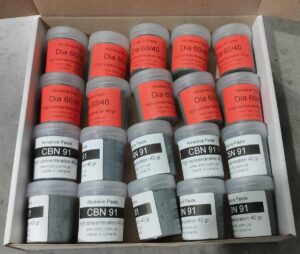
CBN and diamond jaws for surface polishing | KDTU

An abrasive mixture that includes CBN (cubic boron nitride) is CBN paste, which is logical in principle. CBN is the main grinding component, which is a synthetic material. An interesting fact is that this component was created specifically for industrial purposes. It has such properties as high resistance, excellent heat resistance and chemical inertness to iron-containing materials.

If we talk about hardness, then CBN is second only to diamond. But this paste has unique properties that make it indispensable for processing super hard metals, especially at high temperatures. It is widely used for finishing, fine grinding and polishing. We are talking about such materials as high-hardness tool steels, hardened steels and iron-based alloys, nickel, cobalt alloys, ceramics, carbides and ferritic materials. CBN paste is especially important where the processing temperature may exceed the thermal resistance limits of diamond, or in cases where diamond enters into a chemical reaction with the material being processed.

Advantages of CBN pastes:

  1. The first advantage will be the high efficiency of processing hard materials. CBN does not wear out very quickly, so you have the opportunity to work longer and with better results.
  2. The next, no less significant, advantage is heat resistance. The paste does not lose its abrasive properties at high temperatures, which plays an important role in the processing of hardened steels.
  3. The paste copes with its task well, so you will get a well-polished surface at the output.

Diamond and CBN pastes – key differences

CBN is the mouth and diamond mouth of our production | KDTU

And here the question arises – which paste to choose? Diamond or CBN? They are both great, but it all depends on what exactly you are working with. These pastes are the two most common types of abrasives used for grinding, finishing and polishing various materials. Both types are endowed with their own unique properties, which make them very necessary and popular. So let’s consider the differences between them in order to be able to make the right choice.

Diamond pastes are based on natural or synthetic diamond, which is currently the hardest known material. With their help, you can perform extremely fine polishing with a high degree of surface cleanliness. Due to its hardness, diamond paste is perfect for processing hard surfaces. We are talking about glass, ceramics, carbides, stones, non-ferrous metals. These pastes are often used in jewelry, the optical industry and in the manufacture of micro-tools. However, there are some limitations, as diamond is prone to chemical reactions with certain materials and does not tolerate very high temperatures well.

CBN pastes are based on cubic boron nitride, which is inferior in hardness to diamond, and has higher heat resistance and chemical stability. CBN does not react with iron and retains its abrasive properties at high temperatures. This makes it an excellent choice for processing hardened steels, tool alloys, HSS, heat-resistant nickel and cobalt alloys.

There are also some differences in the polishing quality provided by the two types of pastes. Diamond pastes are able to provide a mirror finish, while CBN pastes are more focused on technical results. Yes, they may be slightly inferior in shine, but they guarantee stability and high precision during processing.

Choose diamond and CBN pastes from a reliable manufacturer

High acidity jaws for various robots | KDTU

Diamond and CBN pastes are indispensable tools in the field of high-precision surface treatment, which allow you to achieve exceptional grinding and polishing quality. If you are looking for a proven polishing agent, we have several options that have proven themselves in working with even the most demanding materials. If you still have questions, please contact us at +38 050 889 82 89 or kdtu-1@ukr.net. Our specialists will be happy to provide you with all the necessary information and help you with the choice, because we want every customer to receive the best product.

Follow us on Instagram and Facebook


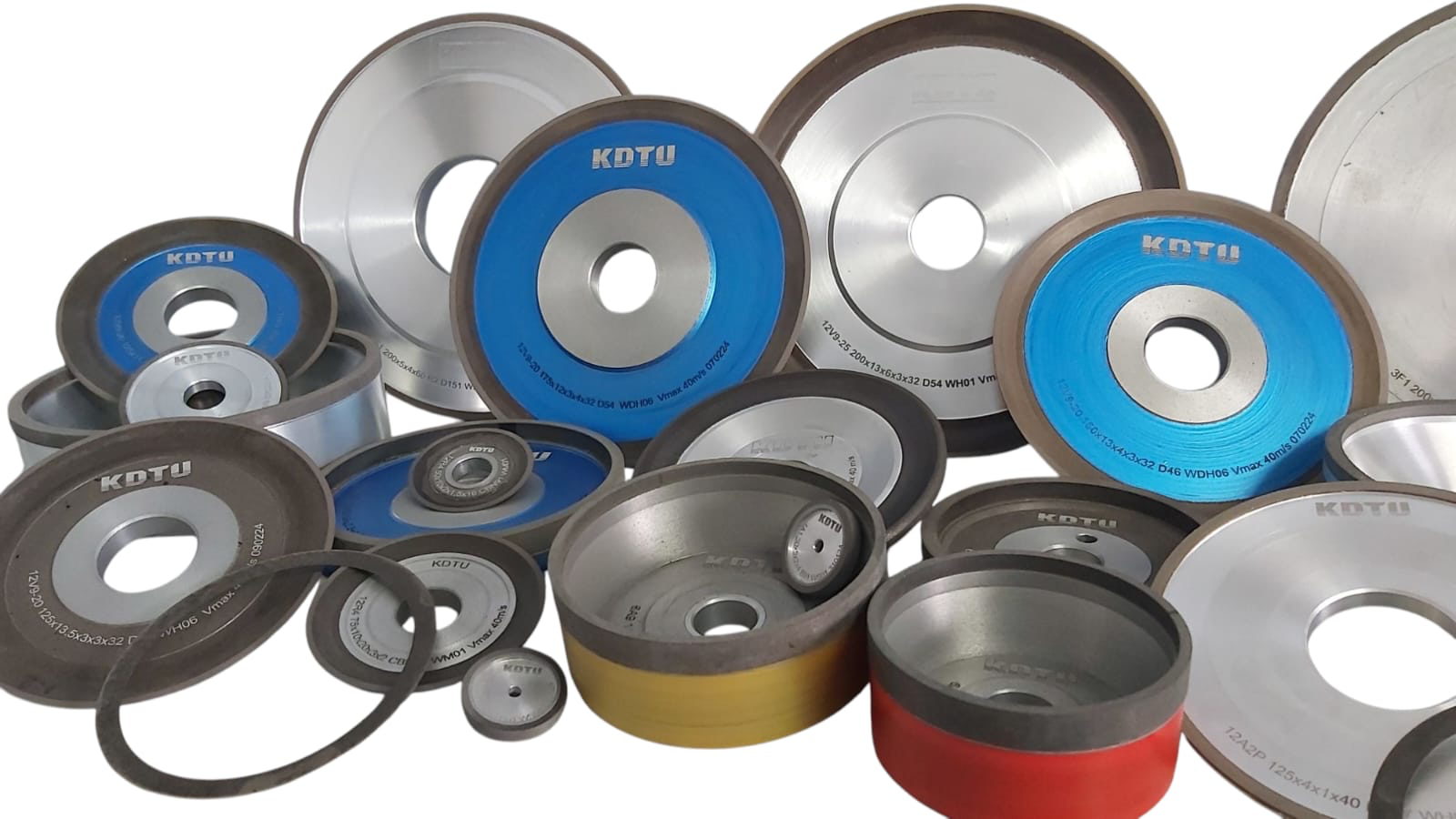
Diamond discs – how to choose?

Choosing the right tools is not an easy task, because you want the price-quality ratio to be equal. Diamond discs are available today in a wide range and in different price categories. Manufacturers are trying to make their products the best, which is undoubtedly great, but not every product may suit you. In this article, we will consider the main recommendations for choosing diamond discs that may be useful to you.

Diamond discs – varieties

Cutting discs

Diamond discs for various needs | KDTU

Let’s start with cutting discs that are used for cutting materials of different hardness. They can be divided into several more types.

The first type is solid, which gives a perfectly even cut line. Most often, people use this type of water-cooled machines to cut tiles, stone, and other building materials that have a glossy surface.

Specialists use turbo segment discs to cut hard metals quickly and efficiently. We are talking about reinforced concrete and concrete structures. Thanks to their special shape, these discs effectively and quickly remove unwanted material.

Segmented diamond discs are the most common on this list. Thanks to them, specialists can cut concrete, natural stone and brick in a dry way. The fact that there are small gaps on the surface of the wheel, which create a kind of segment, makes them an effective tool in the work. For cutting certain materials, you can use specially shaped blades. This shape allows for better heat and chip removal.

Grinding discs

The next variety is grinding discs. They come in different grit sizes and with different compositions of the bonded material. Their scope of application is quite wide. People use them to process a wide range of materials, from hard materials to ceramics and glass. Depending on the work and material for which you need a wheel, you can choose the appropriate grit size. For rough grinding and large material removal, professionals use larger grit sizes. For more versatile use and polishing, they use finer grits. In this case, it is worth starting from your specific needs. This way you can choose the right wheel for the job. It is important to understand what type of work you plan to perform and what hardness the material to be processed will be, thus paying attention to the grit, size of the diamond discs, and the bonding material.

Sharpening discs

Diamond sharpening discs will be the last on our list. They are used for the final sharpening of materials. Thanks to this type of discs, you can change the shape and sharpen carbide cutting materials. With the help of the appropriate marking, you can find out for what purposes you can use the grinding wheel. Due to its efficiency, you will not need much time for the sharpening process, and a tool sharpened with a special diamond wheel will retain its sharpness longer.

The above classification will help you navigate the wide range of discs and their application possibilities. This way, you will be able to correctly choose the right tool that will fully meet your needs and will be able to cope with the task at the highest level.

Diamond discs – what should you pay attention to when choosing?

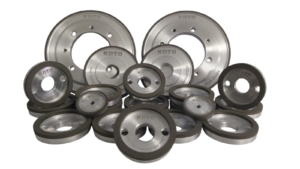
Diamond discs of various grits | KDTU

Knowing the types of diamond discs, their choice is much easier, because you can already orient yourself as to which discs are suitable for your needs. But it is worth emphasizing a few more points that you should pay attention to before buying.

  • The first thing you should pay attention to is the type of work with which the wheel will work. As we already know, for a specific job, you need a specific wheel that can effectively do its job. Also consider the type of material; this is of great importance for carrying out the work.
  • You need to familiarize yourself with the characteristics of the diamond wheel in detail. Check the grit, thickness, inner diameter and type of wheel connections. This will help you choose the most suitable option that will fully meet your needs.
  • Pay attention to the manufacturer. It is important that the products offered to you meet all standards and are of high quality and reliable in operation.
  • It is also worth paying attention to the cost of the product, because it is important that the price-quality ratio suits you completely.
  • It is very important to familiarize yourself with the operating conditions of the tool in detail, because your safety and the effective operation of the diamond wheel depend on it.

Diamond discs from KYOTO DIAMOND TOOLS UKRAINE

Our company manufactures high-quality diamond tools that do their job effectively. On our website, you can familiarize yourself with a wide range and choose the right option according to your request. If you have any questions, please contact us at +38 050 889 82 89 or kdtu-1@ukr.net. We will be happy to answer all your questions and help you with the choice.

Follow us on Instagram and Facebook

Diamond disks – applications in various industries

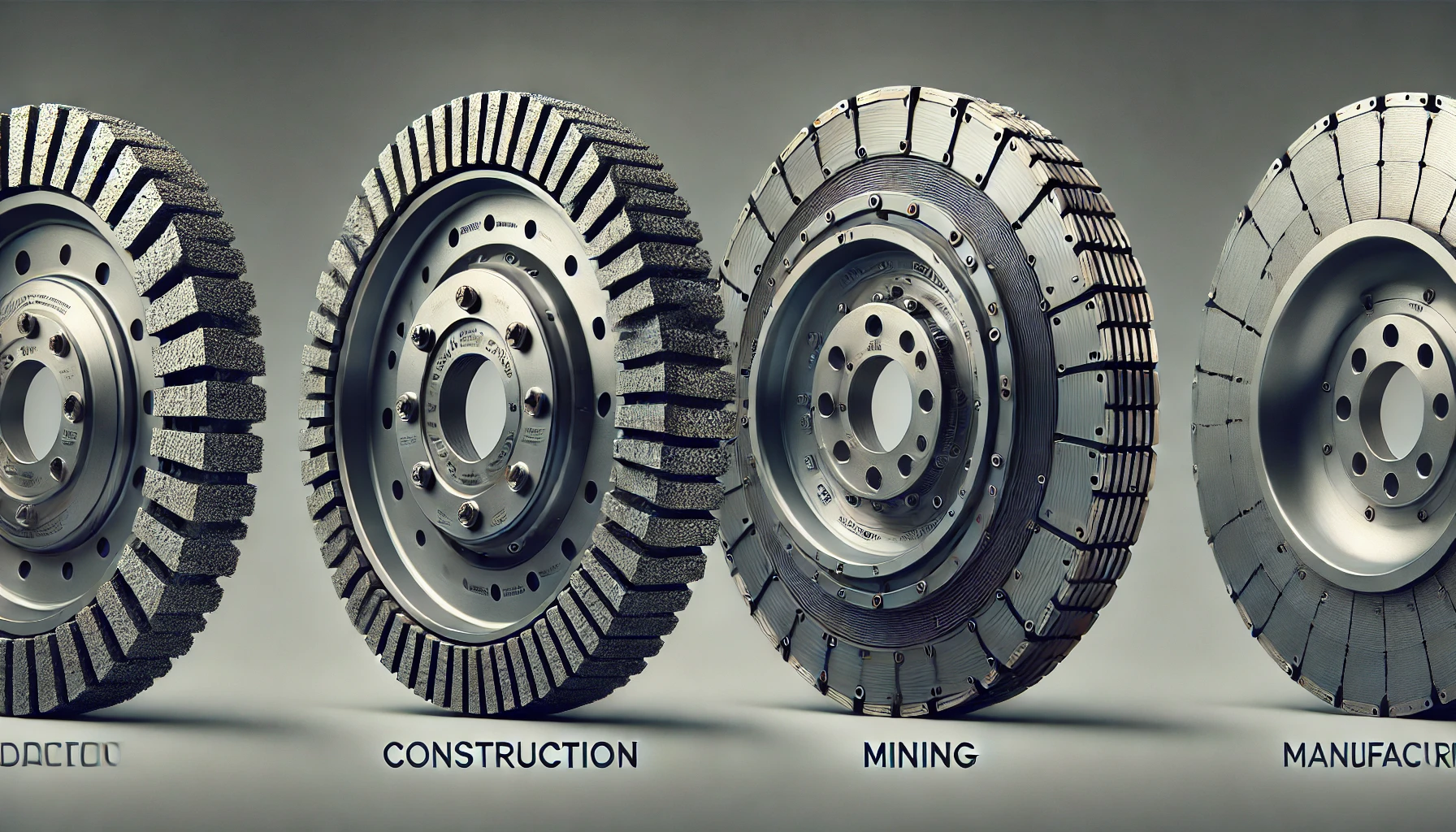
Diamond disks are a special tool that is widely used in industries such as construction, manufacturing, and mining. Usually, this tool has the shape of a circle made of durable material. It is attached to a suitable device and can easily cut and grind hard and abrasive metals. The variety of diamond disks on the market is wide. They can have different sizes and types, which depends on their intended use. Diamond tools are very helpful in various fields. They have significantly simplified and accelerated work with hard metals and other materials. It is precisely due to their efficiency that they are an indispensable tool for specialists.

Application of diamond circles in the construction industry

Diamond cutting discs | KDTU

In the construction industry, diamond disks are often and widely used for cutting and shaping various materials. Most often, people use it in construction to cut concrete using diamond blades. Each of us knows that concrete is a very strong material that is difficult to damage, so ordinary disks will not work in this case. Instead, diamond disks will cope with this task quite well. The master will be able to perform the necessary work without much effort. Thus, with the help of diamond discs, you can dismantle unnecessary concrete structures, and create the necessary openings for doors, windows and ventilation. Make the necessary openings for plumbing, and also, if necessary, cut the wall in the right place.

It is also worth noting that people use diamond blades to cut other building materials. We are talking about materials such as brick, granite, marble and asphalt. They are also famous for their strength, so it is very important to choose the right tool that can cope with the job. Reliable diamond disks will become your indispensable tool in working with these materials.

Application of diamond disks in the manufacturing industry

Diamond discs are an indispensable tool in industrial production. Using them at work, you will get high accuracy and a clean cut. Specialists use this tool in the production of electronic devices. They often use diamond tools to cut semiconductor materials, namely silicon and ceramics. The materials are known to people for their fragility and require careful handling. Therefore, when working with these materials, it is so necessary to use a disk that will be distinguished by its ability to make a clean and precise cut without damaging the product.

It is also worth mentioning the use of this tool for grinding and polishing metal surfaces, stone surfaces and grinding glass edges for further safety when using it. Diamond wheels are also used for cutting glass of various thicknesses.

If you choose the right diamond wheel, it will serve you properly and for a long time. Thereby ensuring stable processing quality. The exceptional ability of the discs to make cuts in hard and brittle materials with minimal possibility of chipping or cracking makes them an indispensable tool in the above processes.

Diamond disks in the mining industry

Diamond discs are used in various industries. The mining industry is no exception. They are used for various operations in which discs play one of the key roles. The first and one of the most common applications of diamond discs is their use in the development and extraction of mineral deposits. Diamond discs are widely used for cutting hard rocks and ores. Thus, miners have the opportunity to effectively extract valuable materials. Diamond discs obtain the necessary rock samples for geological research. Made of durable materials, they effectively process hard rock, ensuring high-quality results. In the modern mining industry, diamond discs are an important tool, because, with their help, you can increase productivity and reduce production costs.

Diamond disks from KYOTO DIAMOND TOOLS UKRAINE

Diamond grinding wheels | KDTU

Undoubtedly, diamond discs bring a lot of benefits and are a valuable tool in various industries. Their use in many areas is irreplaceable and very valuable, because it is they who give the desired result to a person with the necessary accuracy and efficiency. If you are looking for a high-quality and reliable tool, you will definitely pay attention to our assortment. Our company produces the best diamond wheels on the Ukrainian market. In our work, we use only proven materials and work according to well-honed technologies. If you have any questions, please contact us at +38 050 889 82 89 or kdtu-1@ukr.net. We will be happy to help you choose and provide answers to all your questions.

Follow us on Instagram and Facebook