Catalog


 MENU
MENU
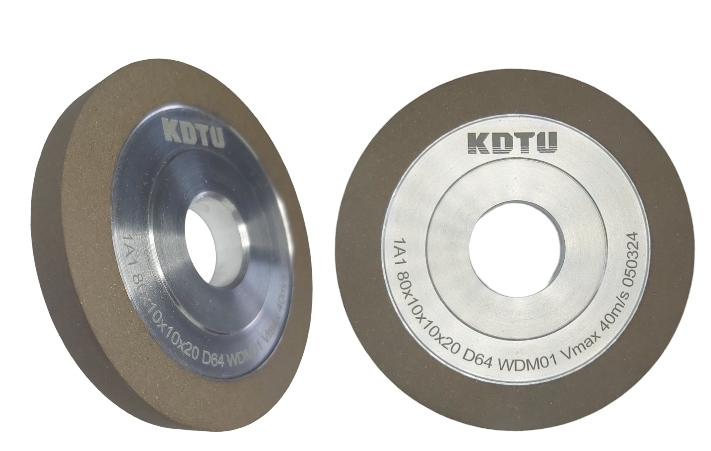
Working with abrasives is not just a technique, it is a strategy. There are many types of abrasives on the market today. These range from conventional corundum to super abrasives. Super abrasives include diamond and cubic boron nitride. Cubic boron nitride is also known as CBN (cubic boron nitride), elbor, or cubanite. Over the years of practice, we have become convinced of one thing. Even small mistakes can turn an expensive set of tools into a pile of unnecessary iron. Below, we will tell you what kind of abrasive to choose to make your work productive. We will also explain what to avoid. This is to ensure the tool you choose does not become a waste of money.
Abrasives: types and uses
Until people invented a way to manufacture synthetic diamond on an industrial scale, the main abrasive material for grinding carbide and various steels was white aluminum oxide, green silicon carbide, boron carbide and some other types of abrasive.
Over time, toolmaking required greater resistance to wear and tear, and a longer life for the sharpness of the tool’s cutting surface. To do this, it was necessary to invent harder steel grades that became more difficult to process with conventional abrasives.
Diamond tools have become a reliable assistant for grinding operations in the machine building and tool industry.
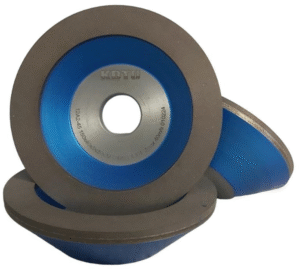
Diamond is the hardest material that exists in nature, so it has greatly facilitated and accelerated the processing of such materials as hard alloy, ceramics, glass, and stone.
But it could not cope with grinding steel. Diamond is synthesized from quartzite-like graphite under high pressure and temperature. Iron is used as a catalyst for the transformation of graphite into diamond.
Therefore, when materials are processed at high speeds, high temperatures are generated in the grinding zone, which, in contact with iron, lead to reverse processes and turn diamond back into graphite.
For these purposes, another super abrasive was synthesized — cubic boron nitride (CBN), which is slightly inferior in hardness to diamond, but can withstand higher temperatures and is inert to iron.
We will discuss it in more detail.
Advantages of CBN over conventional abrasives
The most common material for machining steels is an abrasive. It does an excellent job. However, issues arise when working with unalloyed steels, bearing steels, heat-treated steels, heat-resistant steels, and titanium alloys. These materials have a hardness of more than 55HRC. This is where the problems for manufacturers begin. The part needs to be manufactured quickly to reduce product costs. This is necessary to maintain competitiveness through mass production. However, even the hardest abrasives can only remove 0.5 microns (or microns) of material on such steels. In contrast, CBN can remove from 0.01 mm to 0.1 mm in one pass. This process does not disturb the steel structure.
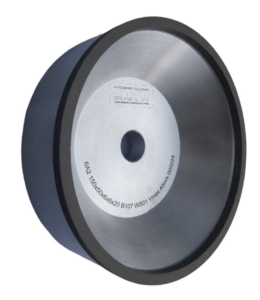
CBN abrasive discs have a lifetime that is hundreds of times longer than the toughest abrasives. And another advantage of CBN tools that our customers have noted is the absence of dust during dry grinding.
Imagine an abrasive wheel. Its diameter is 200 mm or 400 mm. The width is 10 mm or 40 mm. It wears down into dust. This dust disperses throughout the shop. Workers breathe it in.
When grinding with coolant, the dust turns into sludge. This sludge contaminates the machine, coolant, and fluid filters. As a result, related materials need replacement faster.
CBN is also unique in that, unlike conventional abrasives, it can work without cooling without burning the surface of the workpiece. However, this requires the proper selection of the CBN grinding wheel parameters, dimensions, and operating conditions.
CBN on steel does not work
Unfortunately, we often encounter the problem of customers’ distrust of CBN wheels. Many have already tried to replace abrasives in order to speed up the grinding process. They faced the issue of inefficient operation of the super abrasive — seizing the wheel, burning the surface to be processed, or wearing out much faster than a conventional abrasive. And the customer comes to the conclusion that CBN on steel does not work. Yes, such an issue exists if the manufacturer of the CBN tool does not know all the secrets of making a bond for grinding steel. A bond is a multi-component resin-based composition that contains super abrasive powder. Each of these components affects the hardness of the grinding wheel and the ability to recover the working grains, which in turn affects the result of the workpiece processing.
Tips for selecting the right CBN discs
When making the switch from conventional abrasives to CBN abrasive discs, it is important to consider some factors below.
Motor strength
As a rule, small machines for grinding furniture knives are equipped with low-powered motors. Since the abrasive has a much lower hardness and performance, the machine can cope with its task. The main mistake made when switching to CBN wheels is that customers ask for the same working surface parameters as for conventional abrasives. This results in the machine becoming noisy. The surface of the workpiece burns. Additionally, the machine cannot provide the necessary spindle speed. The spindle speed is required for the grinding wheel mounted on it.
CBN works more aggressively and penetrates deeper into the steel surface than conventional abrasive. The super abrasive grain does not crumble like a conventional abrasive. To ensure normal operation, the contact area must be reduced. This is achieved by narrowing the width of the CBN tool by 1.5–2 times.
Speed of rotation
CBN requires a sufficient speed. The optimum value ranges from 2500 to 3500 rpm, depending on the diameter of the abrasive wheel. As a rule, they operate at a minimum speed, so machines for them are made with a speed of 1500 rpm. This is especially true for surface grinding wheels with diameters ranging from 250 mm to 350 mm or 400 mm and above. KDTU was able to select the necessary bonding parameters that ensure the operation of CBN wheels at a minimum speed of 1500 rpm. However, it should be understood that at such speeds, abrasive wheels made by other manufacturers may no longer work.
When selecting CBN wheels for flat grinding, where wheels with a diameter of 350-500 mm and a width of 40-60 mm or 80 mm are usually used, it is necessary to select a CBN wheel with a width 2.5-3 times smaller.
It should also be understood that an abrasive wheel with a diameter of, for example, 500 mm can be worn down to a diameter of 250 mm. Therefore, a CBN wheel can be manufactured in the middle range, i.e., around 350 mm.
Abrasive grains
As a rule, abrasive wheels for grinding are made with large abrasive grains of the F40 or F46 order, which corresponds to an average size in microns of 438 microns and 370 microns. It should be borne in mind that an abrasive wheel with the specified parameters for removing 1 micron of material from a workpiece will actually remove 0.5 microns. This is because the abrasive grain crumbles to a size approximately half that. To 220 microns and 180 microns, respectively. Therefore, the size of the CBN abrasive must be selected with this effect in mind and should be between 250 microns and 200 microns.
Abrasive and its hardness
And the last point, all conventional abrasives are divided by hardness: very soft (F, G), soft (H, I, J), medium (M, N), hard (R, S), and others. All of this depends on the abrasive they are made of, whether it is aluminum oxide, silicon carbide, or titanium. Therefore, the main criteria for selecting a super abrasive wheel over a conventional abrasive are the grain size and the bond characteristics. These are selected according to the operating conditions. Sometimes it takes two or three attempts to find the optimum characteristics of a CBN wheel for maximum performance and maximum durability. As a rule, we first offer a fairly soft bond that will work regardless of the operating conditions of the wheel. Then, at the customer’s request, the bond density or grit can be increased or decreased until the desired result is achieved.
Abrasive: proper use
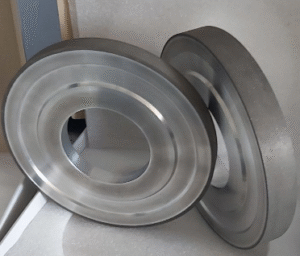
The main condition for high-quality and long-lasting operation of grinding wheels is compliance with the operating conditions. Sometimes, in the pursuit of quick results, operators deliberately overestimate the depth of material removal per pass or the feed rate. Less often, they overestimate the spindle speed. This leads to increased loads on the wheel. As a result, it causes rapid abrasion of the wheel at best. Or it leads to its destruction. Under heavy loads, not only does the load on the abrasive grains increase. The temperature in the grinding zone also rises. This causes the chemical composition of the bond or adhesive to lose its properties. The bond or adhesive holds the bond to the aluminum or steel body. As a result, the working layer of the abrasive tears away from the body.
It is not advisable to constantly remove and reassemble the abrasive disc from one machine to another. This is especially true when the discs are large. This causes the disc to “beat” on the machine and requires time to adjust to the newly installed machine.
We do not recommend modifying grinding wheels by yourself with different grinds of the body or the hole, as this can lead to an imbalance of the wheel and a deterioration in its performance or destruction.
Another important thing to keep in mind is that overdrive modes can increase performance but decrease the wheel’s durability. Therefore, the operator must clearly understand what is more significant to him — either the long life of the tool or high performance at the expense of stability.
Final thought
Working with abrasive tools is all about math: precision + discipline = results. Don’t believe me? If you cut porcelain with a diamond sharpening blade, you’ll spend an hour instead of minutes and end up with crooked edges. If you save money on glasses, you’ll visit a doctor, who will remind you that “cheap” sometimes costs too much.
Your toolkit is an investment. Take care of it, use it wisely, and it will serve you for a long time. And remember: the best tool without knowledge is a piece of metal. Learn, analyze your mistakes, and then even diamond wheels will become not just “disks” for you, but an extension of your professional intuition.
To order abrasive tools, please contact us at +38 050 889 82 89 or send an e-mail to kdtu-1@ukr.net. Our experts will help you with the selection and answer any questions you may have.
We do not sell abrasive discs. We are selling you the economic benefits that you will gain from working with our tools. Sometimes people say that wheels are expensive. When comparing our competitors’ offer with ours, we always calculate what benefits our customer will get. Either he wins on the purchase price, or they get a tool that works, for example, 4 times longer and costs half as much. A more expensive tool with better work quality ultimately yields economic benefits through significantly longer work, reduced equipment downtime due to time saved on re-installing and tooling, and higher productivity per hour of work.
With a more expensive tool, you will be able to produce more products per hour, thus covering your costs for purchased tools, increasing the output of your finished products, which can cost more per unit than a grinding wheel.